



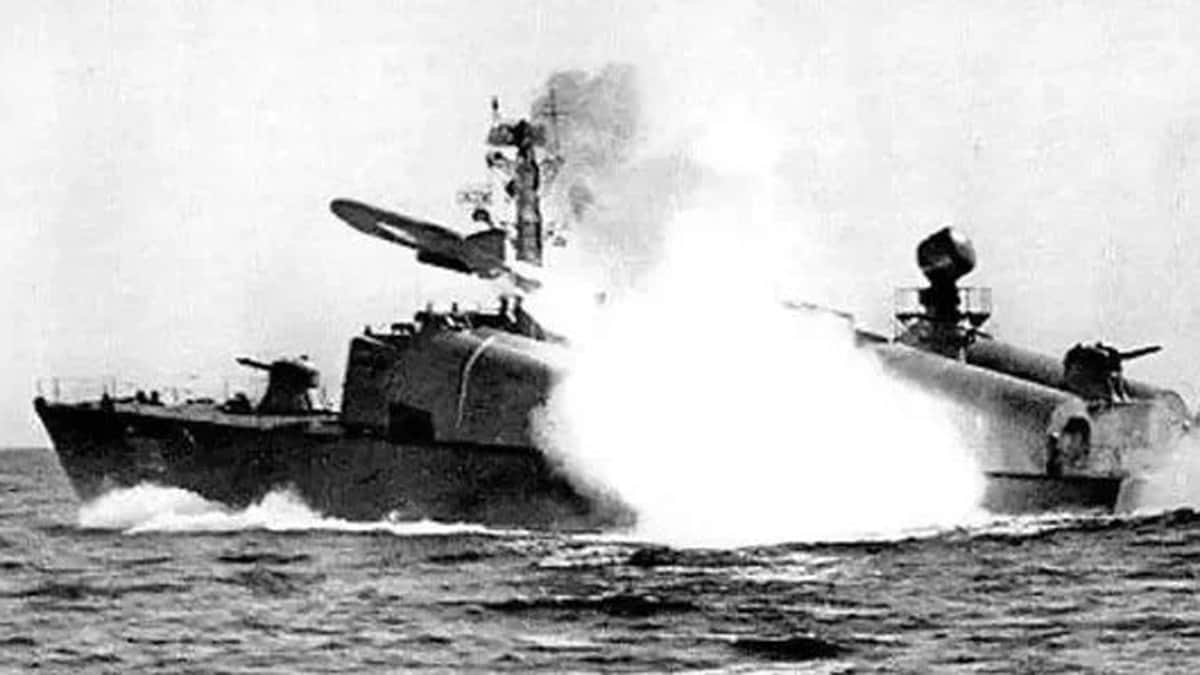
On Thursday (December 4), the Indian Navy celebrates Navy Day to commemorate the Indian Navy's attack on Karachi Harbor during Operation Trident in the 1971 Indo-Pak War.
Operation Trident was a major naval offensive in which the Indian Navy sank several Pakistani vessels, marking a historic use of anti-ship missiles and significantly damaging Pakistan's naval capability.
Navy Chief Admiral Dinesh K Tripathi said on Wednesday that Navy Day is celebrated on December 4 each year to commemorate the "daring and decisive attacks of the Indian Navy on and off Karachi harbour during the 1971 India-Pakistan war."
"The day also offers us an opportunity to pay homage to our brave warriors, whose courage and supreme sacrifice continue to inspire us in service of the Navy and the nation," he added.
Operation Trident
The war of 1971, which was fought on both the Eastern and the Western front, was the first in which India engaged all three Services on a large scale.
The Indian naval offensive began on 4 December, when aircraft from INS Vikrant and ships of the Eastern Fleet launched strikes against military targets in East Pakistan, causing extensive damage to military installations and harbours of Pakistan.
On December 4, 1971, the task group assembled for the operation comprised three Vidyut-class missile boats—INS Nipat, INS Nirghat, and INS Veer—from the 25th ‘Killer’ Missile Boat Squadron. They were escorted by two Petya-class frigates, INS Kiltan and INS Katchall, along with a fleet tanker, INS Poshak. The Petya-class frigates were tasked with providing communication and control support.
By 5.30 PM, the group had reached a position off Dwarka, about 150 miles from Karachi. The order to commence Operation Trident was issued, and the force advanced at high speed directly toward Karachi. One of the four missile boats was ordered to remain on patrol off Dwarka to provide cover for the force on its way back.
During the operation, INS Nirghat engaged a contact to the northwest, sinking the Pakistani destroyer PNS Khaiber with two missiles. INS Nipat targeted a northeastern contact, later identified as the merchant vessel MV Venus Challenger, and destroyed it with two missiles. A third contact to the north was struck by INS Veer, which set the vessel—later confirmed as the Pakistani minesweeper PNS Muhafiz—ablaze before it sank.
Nipat and Veer were ordered to advance toward Karachi. Veer attacked two harbor targets, while Nipat launched a missile at the Karachi oil refineries at midnight, causing a massive explosion visible for miles. Afterward, a withdrawal was ordered, but communication issues left INS Kiltan unaware of the signal, causing it to approach Karachi alone until it realized the rest of the group had already turned back. The task force regrouped and returned toward the Saurashtra coast, refueled on December 5, and reached Bombay on December 6.
While Indian Indian Navy lost anti-submarine frigate Khukri during the naval operations in the Arabian Sea, it managed to primary objective by establishing effective supremacy in the sea. The Pakistan Navy remained confined to the safety of Karachi harbor throughout the entire duration of the war.
—Information courtesy: usiofindia.org
