



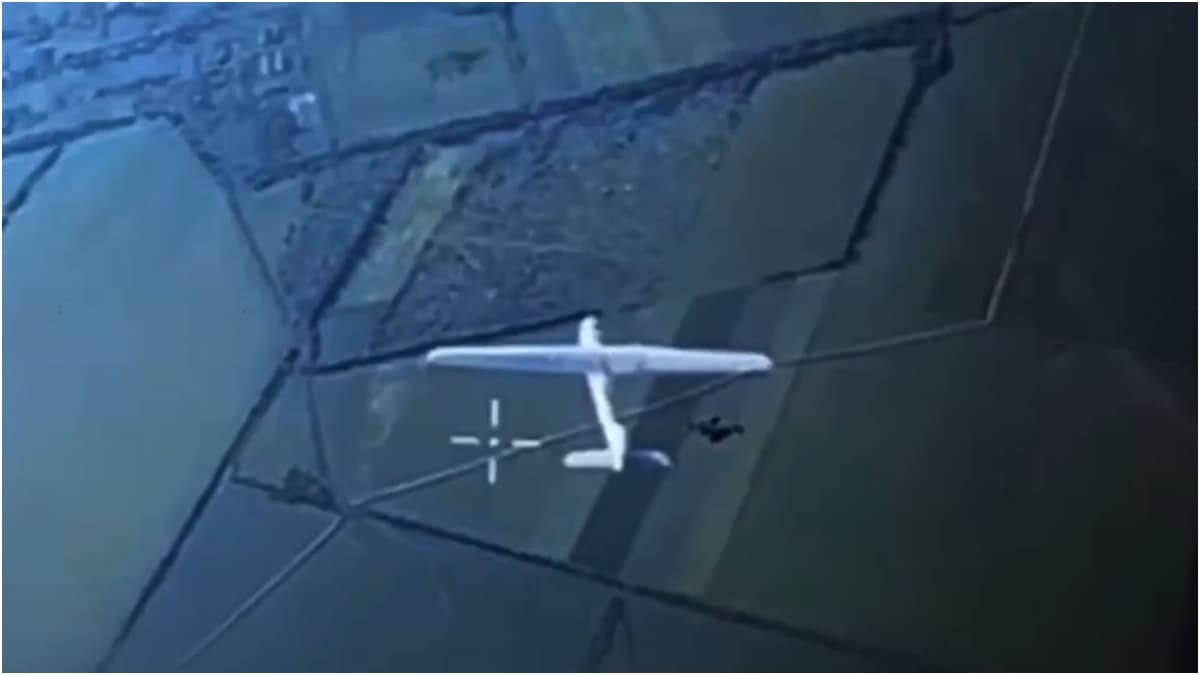
A kill-chain can be described as a methodology for a military to find a target and hit it accurately, as fast as possible. If the 20th century was the age of the tank and aircraft, the 21st century is emerging as the age of the ‘digital kill-chain’, where the decisive factor is the speed with which a force can detect, process, decide, and strike the adversary’s critical targets - using high-tech ‘digital’ means.
Four years into the Russia-Ukraine war, one conclusion is now amply clear: the side that wins the digital kill-chain wins the war. Guns, tanks, battalions, and brigades still matter—but only as much as the kill-chain that enables them. In this unforgiving battlefield, Russia has achieved something far more important than building more drones or firing more shells. It has mastered the integration of sensors, shooters, data, drones, electronic warfare, and cyber effects into a single, continuous, lethal ecosystem.
Ukraine can claim bravery, resilience, Western support, and ingenuity. On the other hand, Russia can claim something else entirely: operational dominance through systematic digitalisation of war. And India, caught between two adversaries–equally technologically hungry as Russia–must take note. The war in Ukraine is not of Europe’s interest alone. It is a preview of the way wars are going to be fought in the future. In an earlier article, the author had highlighted the lessons from Ukraine's innovation and improvisation of drone warfare; in this one, he has drawn wisdom from Russia's apparent mastery of the digital kill-chain.
Russia’s mastery of the digital kill-chain
The early weeks of the Russian invasion were mocked across Western capitals. Analysts derided Russian “Soviet-era tactics,” poor battlefield awareness, and clumsy intelligence, surveillance and reconnaissance (ISR). But by 2023, the tone shifted. Russia was no longer improvising. It was evolving.
Today, Russia fields a kill-chain so tightly integrated that it collapses the time between detection and destruction to mere seconds. The transformation is not just technological—it is cultural. The Russian military stopped waiting for permission, stopped adhering to hierarchy, and allowed young soldiers with cheap drones and rugged tablets to call in precise strikes.
This is not the Russian army of Cold War caricature. This is a ruthlessly adaptive, digitally fluent war machine fighting a real-time, algorithmic war.
Persistent ISR and drone integration
Russian drones now blanket the Ukrainian front like a digital fog. This is not occasional surveillance; it is persistent, omnipresent ISR. It is an unblinking eye in the sky, watching everything, all the time.
Russia does not simply deploy more drones; it deploys drones smarter - drone saturation is now a strategy. Swarms of cheap first-person-view drones (FPVs) skim trench lines. Loitering munitions wait like airborne predators. Long-endurance unmanned aerial vehicles (UAVs) orbit high above, feeding real-time imagery into a central stream. The entire battlefield becomes a transparent grid.
In this grid, Ukrainian movements become “events” in a digital system, not secrets. A tank rolling out of a tree line is no longer a tactical choice. It is a data point waiting to be turned into a targeting order.
Russian FPV operators—some barely in their 20s—are now among the deadliest combatants in the war. They operate drones like gamers on a digital battlefield, assisted by AI that highlights targets, real-time feeds from multiple drones, digital maps updated every few seconds, and team coordination tools built on commercial platforms. These FPV units have turned Ukrainian armour into a clay pigeon range. Even expensive Western platforms fall prey to drones that cost less than a mid-range smartphone.
The emergence of semi-autonomous drone swarms—coordinated through the new drone control system called Rubicon—marks a darker threshold. Russia has demonstrated that swarms do not need full autonomy to be devastating. A handful of human operators guiding a semi-cooperative swarm is enough to shatter logistics depots and troop concentrations.
Ukraine is fighting a modern Hydra: cut off one drone, three more appear.
Artillery PGMs and Automated Targeting: The New Reconnaissance-Strike Complexes (RSCs)
Russia has long been an artillery superpower. But what it has built in this war is something entirely new: The world’s most responsive, automated, drone-driven artillery ecosystem.
Russian digitalised RSCs compress what used to be a 20-minute process into two minutes. In many cases, into less than a minute.
Drone sees target.
Target flagged on digital map.
Artillery battery receives coordinates automatically.
Drones adjust fall-of-shot mid-strike.
Target destroyed.
No command approval. No paperwork. No hierarchy. This is war at machine speed.
Russia is mass-producing cheap guidance kits for dumb bombs and artillery shells. When paired with drones, even crude munitions achieve frightening accuracy. Not even Western militaries possess this level of integration on such a scale. With tablets and battlefield apps, any Russian fireteam can observe, target, and coordinate strikes. This democratised, decentralised lethality is now Russia’s asymmetric advantage.
Electronic Warfare (EW): Spectrum Dominance
Drones cannot fly, and guided munitions cannot guide without the electromagnetic spectrum. Russia understood this early and invested accordingly. The result: The most extensive battlefield EW architecture seen in any conflict since WWII.
Russian EW units now: Jam Ukrainian drones across entire districts, spoof GPS signals at scale, disrupt Starlink terminals in key sectors, interfere with artillery radars and block frontline communication networks. Even NATO EW specialists privately concede that Russia’s EW capabilities were underestimated for decades.
Crucially, Russian EW is not static. It is agile, adaptive, powered by AI, and capable of electronic ambushes—brief, intense bursts of jamming timed to coincide with drone strikes or missile barrages. Ukrainians have called Russia’s EW “a digital minefield.” Once you enter it, you are already a target.
Cyber operations
Russian cyber units quietly shape the battlefield long before drones buzz overhead. This is the invisible front where Russia degrades Ukrainian networks, infiltrates communications, and disrupts battlefield management systems.
Cyber attacks frequently coincide with major offensives: power grids go down, command software crashes, satellite links fail, and logistics tracking is disrupted. Russia treats cyber and kinetic operations as a single continuum. Most countries still treat them as separate domains. That gap will be fatal in the next war.
Agility, redundancy, and civil-military fusion
The greatest Western miscalculation was assuming Russia would fight the war it began, not the war it learned. Instead, Russian forces evolved into a battlefield laboratory. Russian units test new drones, EW payloads, and battlefield software on a weekly—sometimes daily—basis. Successful ideas spread across the front in days, not months.
Russia combines military radios, civilian networks, commercial encryption apps, mesh networks, and satellite links. Destroy one channel, and five others remain.
Russia has fully embraced commercial technology: civilian drones, Chinese components, volunteer engineers, civilian logistics channels, and commercial satellite networks. War in Russia is now a whole-of-society enterprise. This is what modern-day resilience should look like.
Battlefield impact and limitations
As for impact on the battlefield, the consequences are brutal and undeniable: Ukrainian strongpoints are destroyed within hours of detection. Armoured columns survive only in short, covert sprints. Supply routes are constantly hunted. Any radio transmission risks a drone strike. Traditional warfare is dying in Ukraine. The trenches remain, but the rules have changed.
On the other hand, Russia still faces shortages of high-end chips and attrition of advanced drones. But its ability to mass-produce cheap drones and integrate commercial components has offset the impact of sanctions. In other words, Russia does not need perfection. It needs adaptation. And it has mastered adaptation.
Lessons for warfare in the South Asian context
The strategic environment in South Asia could well mirror the Russia-Ukraine war far more than what we may imagine. Future conflict will not wait for traditional bureaucratic cycles. India faces two adversaries that use drones aggressively, invest heavily in EW, deploy cyber units against Indian infrastructure, experiment with battlefield AI and embrace digitisation of war. Cyber intrusions and contested EW spectrum now reflect the baseline, not the exception.
Consequently, India must internalise the lessons of Russia-Ukraine not in years, but in months:
1. Expedite building a real-time kill-chain
India cannot win the next war with siloed data, slow approvals, and compartmentalised commands.
It needs unified ISR, multi-domain fusion centres, real-time targeting, AI-assisted decision support, and shared data links across the Army, Navy, Air Force.
2. Frontline EW and spectrum warfare
EW units pushed to the tactical edge are the need of the hour: jammers with mobility, spoofers for counter-drone operations, spectrum monitoring grids, resilient communications, and hardened data networks. If India cannot hold the spectrum, nothing else will matter.
3. Mass-produce counter-drone systems
India requires layered counter-UAS defences, not boutique programmes: interceptor swarms, automated AA guns, loitering counter-drones, and mobile directed-energy units.
4. Achieve true jointness
Theatre commands are not bureaucratic redesigns. They are kill-chain enablers. They must be accelerated, not debated endlessly.
5. Indigenise or Perish
India must produce: Drones, EW suites, encrypted radios, battlefield software, secure data links and AI reconnaissance tools. Dependence on imports in a high-tech war is a strategic death sentence.
Conclusion
The Russia–Ukraine war has obliterated old doctrines and exposed a brutal truth: modern warfare is digital warfare, and the digital kill-chain decides everything on the battlefield. Russia appears to have mastered it through speed, adaptation, decentralisation, and relentless experimentation. Ukraine, brave and innovative as it is, has struggled to compete with Russia’s machine-speed battlefield.
For India, the lesson is not subtle. The next war will be fought under constant surveillance, persistent drone threat, cyberattack, and EW contestation. Victory will not go to the strongest or the bravest—but to the fastest, the most integrated, and the most digitally adapted.
India’s choice is simple: Build the kill-chain of the future—or be outmatched and outpaced by the kill-chain of someone else. Mastery of the digital kill-chain will be the single-most important act of military deterrence, with concomitant effects even against cross-border terrorism.
