



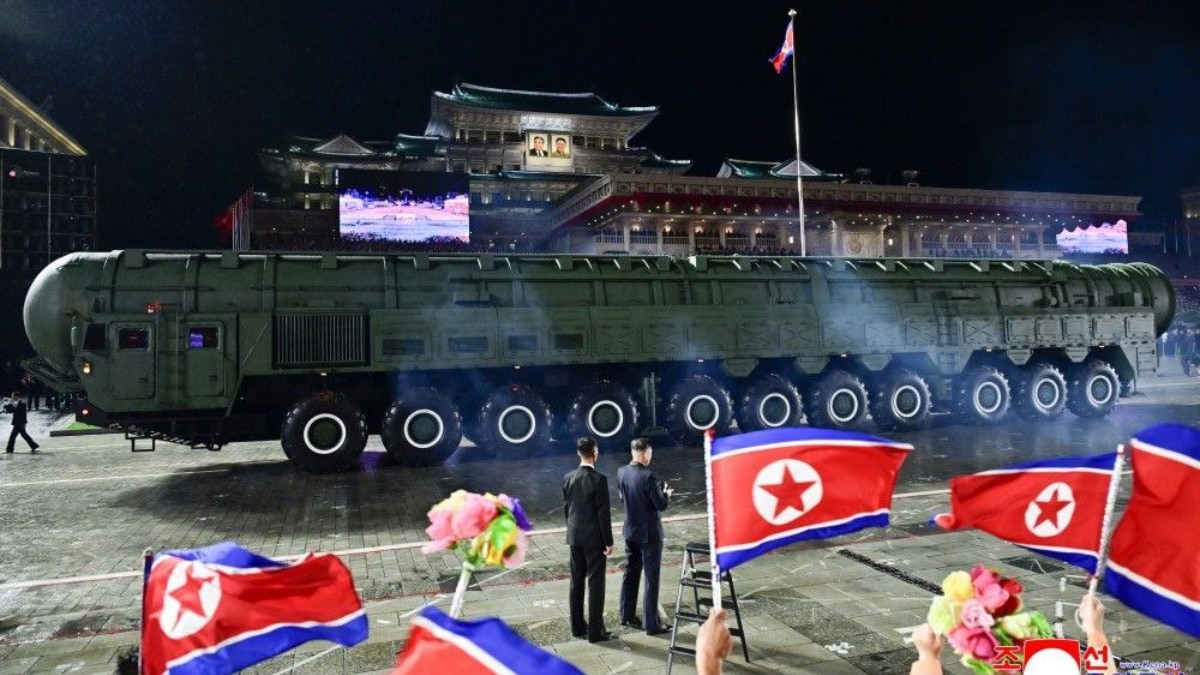
North Korea unveiled the 'Hwasong-20' intercontinental ballistic missile (ICBM)—the most lethal addition to its arsenal—for the first time during a military parade marking the 80th anniversary of the founding of the ruling Workers’ Party. Kim Jong Un has called for the development of multi-warhead systems that would improve the chances of penetrating missile defences, and some experts say the Hwasong-20 could be designed for that purpose.

Theoretically, with an operational range of 15,000 km, the Hwasong-20 is capable of striking anywhere in the United States mainland, although many doubt if Pyongyang has the technology to perfect the missile's guidance system and the ability to ensure the payload's atmospheric re-entry.
The parade also featured Kim's newest tanks, artillery systems, and drones, which have been a key focus of his efforts to expand his conventional military capabilities after he spent much of his early rule concentrating on nuclear weapons and ballistic missiles.
For those interested, here are five things to know about Kim Jong Un's Hwasong-20 ICBMs:
1. Hwasong-20s are reportedly designed with a larger, rounder nose, which is reportedly an indication that they could contain multiple independently targetable re-entry vehicles (MIRVs). This would allow a single missile to carry several independent nuclear warheads, increasing the ability to penetrate defence systems. This is a major challenge to most missile defence systems in the world, reports said.
2. At least three of them were wheeled out on 11-axle launcher trucks. As per North Korean state media, their engines are built with carbon fibre, which is more powerful than past models.
3. Hwasong-20s use solid-fuel rockets, which are more mobile, harder to spot for spy satellites, increase deterrence capabilities, and can be launched on short notice. Another notable feature of this ICBM is its advanced guidance system, which could integrate inertial navigation technology combined with a domestic GPS system or optical sensors to improve accuracy. They also do not require the loading of cryogenic propellants immediately before launch.
4. Earlier, Vietnamese media reports had claimed that its engine is manufactured from carbon-fibre-reinforced composite materials, which increase strength, reduce weight, and tolerate higher temperatures—especially important for the warhead’s re-entry phase. This enhancement could enable the missile to carry a larger payload or achieve greater range.
5. Despite its intimidating strike range, experts are not certain if the missile’s re-entry vehicle capability is foolproof. This is a crucial factor for surviving atmospheric re-entry before striking targets with accuracy. This theory stems from the fact that during Kim's previous ICBM tests, the warheads often followed steep, high arcs to avoid overflying neighbouring territory and have not conclusively demonstrated warhead survival through re-entry.
