



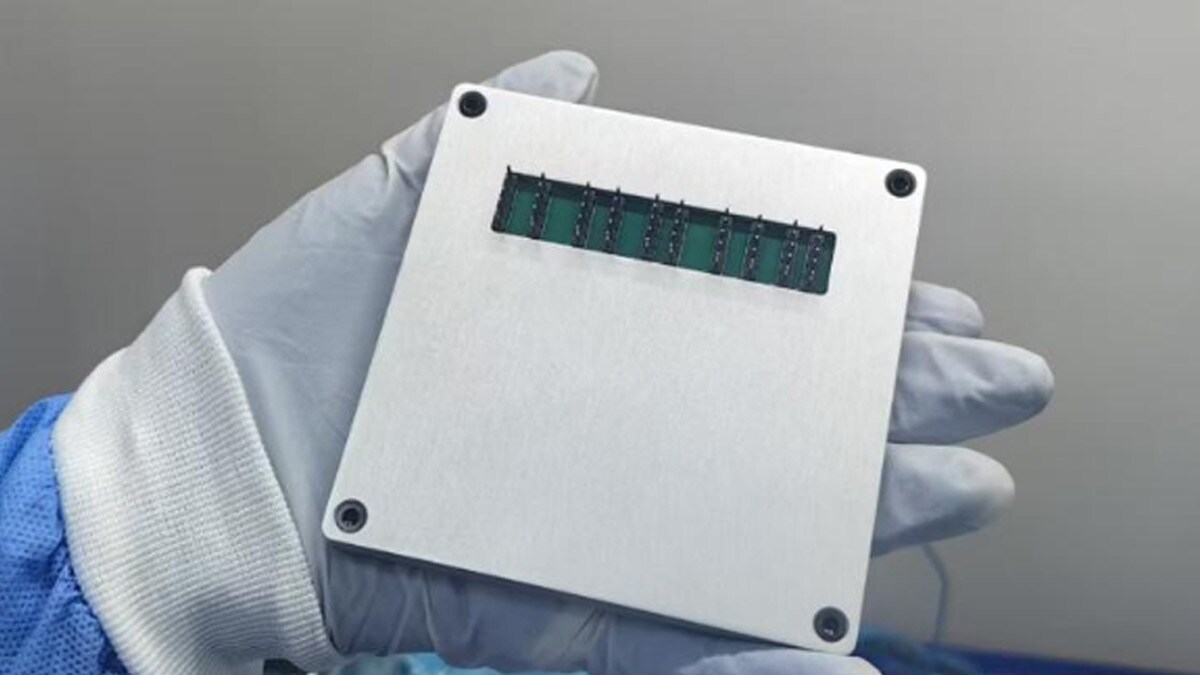
A Chinese company has come out with a claim that it has developed the prototype of a carbon-14 (C-14) nuclear battery, which reportedly can last for a century without being charged, and has wide-ranging applications, including in healthcare and space exploration.
The nuclear battery, named Zhulong-1 after the mythical Chinese dragon deity which is a symbol of eternal light and energy in China's ancient text Shan Hai Jing, can survive in extreme conditions and temperatures, including the deep ocean, Antarctica, and on the moon and Mars.
The battery can power permanent implants like brain-computer interfaces or cardiac pacemakers and support networks of trillions of sensors for the Internet of Things, Zhang Guanghui, technology leader of the battery project said.
Wuxi Beita Pharmatech Co., Ltd, developed the nuclear battery in collaboration with Northwest Normal University, according to news agency Xinhua.
Nuclear batteries differ fundamentally from conventional chemical batteries as they convert radioactive decay energy into electricity.
"The core innovation of Zhulong-1 lies in the use of C-14, a radioactive isotope with a half-life of 5,730 years, which is paired with a silicon-carbide semiconductor to generate power," Xinhua quoted Zhang as saying.
“Theoretically, the battery could last for thousands of years thanks to the long half-life of carbon-14 at 5,730 years," South China Morning Post quoted Zhang as saying.
A Zhulong-1-powered LED functioned for nearly four months, in a live demonstration.
The battery can operate steadily within a temperature range of minus 100 degrees Celsius to 200 degrees Celsius, with an energy density 10 times higher than commercial lithium-ion batteries, and a degradation rate of less than 5 per cent over a designed lifespan of 50 years, Cai Dinglong, head of the battery project, said.
While the company has only spoken about its civilian applications, the nuclear battery has significant potential for defense applications due to its ultra-long lifespan, high energy density, and ability to operate in extreme environments. They can sure provide continuous, maintenance-free power to drones, and remote surveillance, and IoT networks and underwater and deep-sea monitoring systems.
