



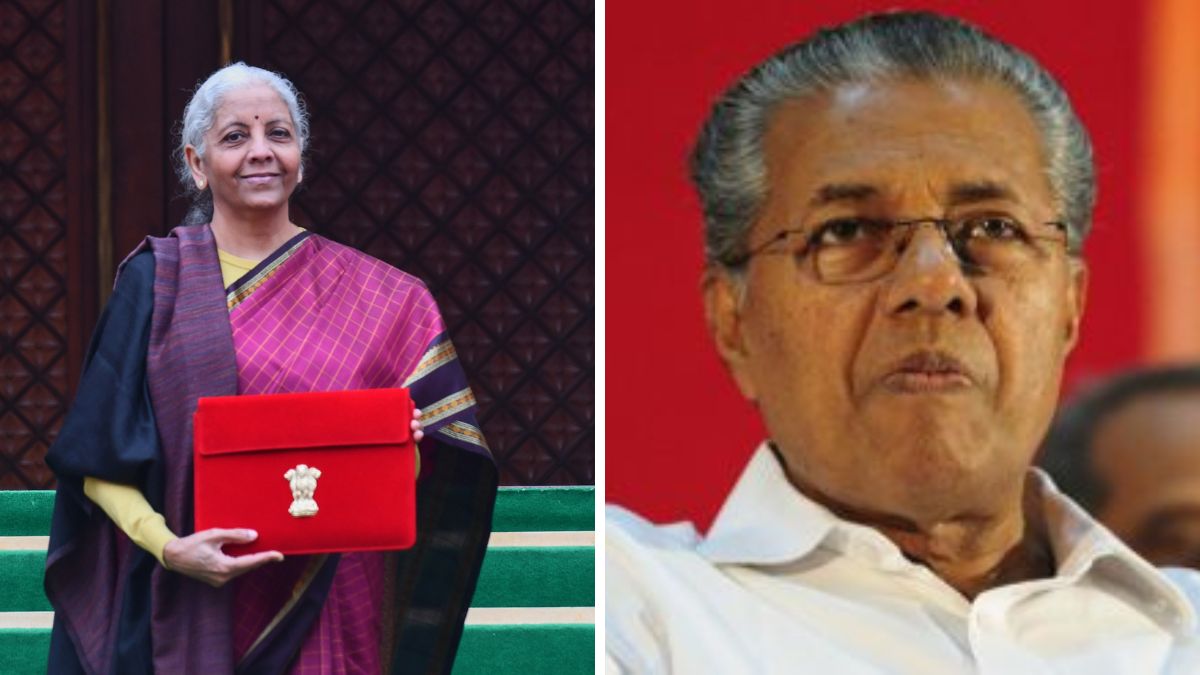
The Union Budget had little to offer for Kerala as several highly anticipated projects, including an AIIMS and a high-speed rail project, did not find a place in it.
Although seven high-speed rail projects were announced for states, including neighbouring Karnataka and Tamil Nadu, Kerala was excluded. There was also anticipation that Vizhinjam Port–related announcements would feature in the Budget, but that too did not happen. Further, the special financial package requested by the state was not granted.
Major projects for Kerala were limited to a mineral corridor and a sea turtle conservation project. The state’s demand for a 50 per cent share was also rejected, with the Centre sticking to the existing 41 per cent formula.
Neither the high-speed rail plan proposed by Metroman E. Sreedharan nor the state government’s proposed RRTS (Regional Rapid Transit System) found a place in the Union Budget. The Kerala government’s original high-speed rail project, K-Rail, never took off. Sreedharan later proposed an alternative, which the state government said it would support, arguing that it would back any plan that improves connectivity in the state.
Notably, Sreedharan claimed that he knew in advance that there would be no announcement on high-speed rail in the Union Budget. He blamed the state government, saying the project was delayed because the state had not officially informed the Centre that it had dropped the K-Rail proposal. Earlier, Sreedharan had criticised the state government’s RRTS plans, calling them impractical.
Though three All-India Institutes of Ayurveda were announced in the Union Budget, it remains unclear whether any of them will be located in Kerala, despite the state being widely regarded as an Ayurveda hub. New schemes for coconut, cashew, and cocoa are expected to benefit the state. The Union minister announced a dedicated programme for cashew and cocoa to make India self-reliant in raw cashew and cocoa production and processing, and to enhance export competitiveness.
Similarly, the Finance Minister announced a Coconut Promotion Scheme to increase production and enhance productivity through various interventions. As a major producer of these high-value agricultural products, Kerala is expected to receive some support.
The budget also includes an announcement to transform the medical tourism sector into a major source of revenue and employment. It proposes extending support to states to position India as a global hub for medical tourism. As part of this plan, five regional medical hubs will be established, with scope for private sector participation. The initiative aims to integrate treatment, education, and research. The Centre says this will generate significant employment opportunities not only for doctors but also across allied sectors.
At present, Kerala is able to attract less than 10 per cent of those coming to India for medical treatment and wellness care. In 2024, an estimated 7.5 lakh foreign nationals travelled to Kerala for treatment. From Ayurveda and wellness tourism alone, the state earned about ₹13,500 crore. Experts point out that connectivity remains Kerala’s biggest challenge. As a result, most foreign patients tend to travel to cities such as Delhi, Mumbai, and Chennai. However, there are suggestions that improving connectivity and effectively using the support announced for medical tourism could significantly multiply Kerala’s revenue from this segment.
Kerala Chief Minister Pinarayi Vijayan criticised the Union Budget, saying it reflects the “Centre’s continued neglect of Kerala.” He said Union Finance Minister Nirmala Sitharaman had “deliberately chosen to forget that Kerala is part of India’s map.” Long-standing demands of the state—an AIIMS, seven high-speed railway corridors, and a special package for the development of the Vizhinjam port—had all been ignored, he said. The Chief Minister also noted that rejecting the demand to increase the Finance Commission share and continuing with the existing 41 per cent formula weakens federal principles. “Central ministers from Kerala must answer for this neglect,” he said.
As criticism mounted that the Union Budget was a disappointment for Kerala, BJP state president Rajeev Chandrasekhar dismissed the allegations as false propaganda. He questioned why the state government had failed to implement projects already sanctioned by the Centre.
“The Centre is providing projects, but the state is not implementing them. Those who say Kerala is not getting anything should be asked why the projects already given are not being carried out. The state government has not been willing to acquire land for an AIIMS. Even after funds were allocated under the PM Awas Yojana, the state has done nothing,” he said.
Chandrasekhar added that merely announcing projects for Kerala is meaningless if they are not implemented for years. “For projects to be executed, an NDA government must come to power in Kerala. Only then will a new chapter of development begin. The Budget has announced many opportunities for the youth, but the state government needs the capacity to implement them,” he said.
