



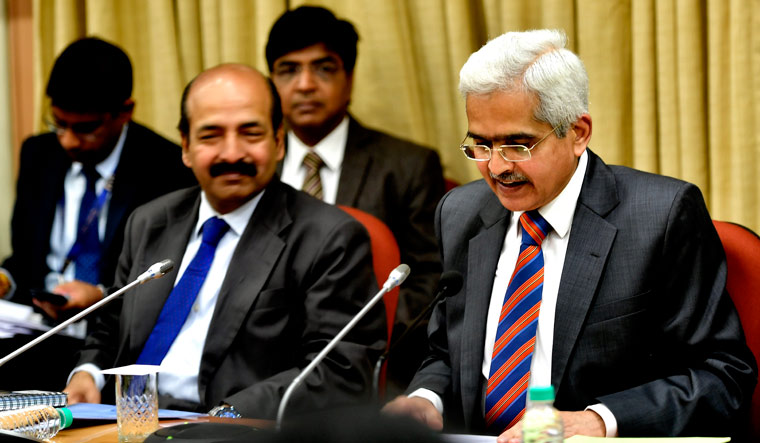
It's good news for borrowers expecting interest rates to come down this year. The Reserve Bank of India sprang a surprise on Thursday, reducing the benchmark repo rate by 0.25 per cent (25 basis points) to 6.25 per cent from 6.50 per cent, citing retail inflation, which has continued to trend below projections.
The monetary policy committee (MPC) also changed its stance to “neutral” from that of “calibrated tightening,” which most analysts had expected.
“The MPC noted that global growth is slowing down across key advanced economies and in some emerging economies as well. World trade is also losing momentum. While international commodity prices, especially of crude, have recovered from their December lows, they remain soft. In consonance, inflation has edged down,” said Shaktikanta Das, governor of RBI.
In the MPC meeting in December, the consumer price index inflation was projected in the 2.7 per cent to 3.2 per cent range for the second half of the current financial year ending March 31, 2019. The actual inflation in the third quarter was at 2.6 per cent. Inflation has been driven lower primarily by continued softness across food prices, while core inflation (barring food and oil prices) has remained elevated.
The MPC expects inflation to remain soft in the near term, but it also flagged uncertainties, including volatile vegetable prices, hazy oil price outlook, the unusual spike in prices of health and education, volatile financial markets, and continued geopolitical uncertainties (trade tensions, Brexit etc) that will warrant careful monitoring.
The MPC has now revised its CPI inflation projections downwards and sees it at 2.8 per cent in the fourth quarter ending March, 3.2-3.4 per cent in the first half of 2019-2020 and 3.9 per cent in the third quarter of next year. Under the inflation targeting policy, the central bank's inflation target has been at 4 per cent, plus or minus 2 per cent.
Das said that the possible impact of the recently announced interim budget, where the fiscal deficit target was missed and several sops in the form of income support for marginal farmers and tax rebates for individual tax payers earning up to Rs 5 lakh were announced was also taken into consideration in its inflation and growth estimates. The MPC also noted the lower GST collections, but is expecting it to pick up this year.
India’s economy grew at 7.1 per cent in the July-September quarter, sharply lower than the 8.2 per cent growth in April-June. In the last MPC meeting, the central bank had projected India’s GDP growth for 2018-19 at 7.4 per cent. It now expects growth in 2019-2020 to be also around 7.4 per cent. The rate cut and shift in stance of RBI should give some fuel to the economy.
“The shift in stance of the monetary policy provides flexibility and the room to address the challenges to sustain growth of Indian economy over coming months, as long as inflation outlook remains benign. The decisions of the MPC in this regard will be data driven and in consonance with the primary objective to maintain price stability while keeping in mind the objective of growth,” said Das.
Analysts were pleasantly surprised by the new governor’s pro-growth views, rather than just focusing on inflation targeting.
“Growth back in the RBI’s vocabulary, not as a risk to price stability, but as a legitimate target. Fiscal concerns and the inflationary consequences seem to be underplayed,” said Abheek Barua, chief economist at HDFC Bank.
The dovish tone by the MPC has led many to now believe that there could be at least one more interest rate cut this year, if the inflation remains benign as is expected.
“Market expectations were more of dovish (stand) and rate cut in future. Markets will start pricing in the possibility of one more rate cut in next six months, if oil prices remain low,” said Kunal Shah, fund manager-debt at Kotak Mahindra Life Insurance Company.
Sujan Hajra, chief economist at Anand Rathi Financial Services also expects the central bank to lower rates by 0.50 per cent in 2019.
“RBI’s MPC has based its policy decision of a cut in interest rates and change in policy stance primarily on account of decline in inflation and expectations that the headline inflation would remain benign till Q3 FY2020...There could be a reduction of interest rates in the range of 25-50 bps (0.25-0.50 per cent) in FY2020,” said Madan Sabnavis, chief economist at CARE Ratings.
What needs to be seen now is whether banks will pass on the rate cuts to its customers.
“Repo rate cut will also feed into key benchmark rates and the new lending norms for retail borrowers that become operational from 1st April 2019. This will boost retail demand for both housing and auto loans, which are in a majority of the cases priced on a floater basis,” said R.K. Gurumurthy, head – treasury at Lakshmi Vilas Bank.
Analysts say a cut in interest rate could come as a big relief, especially for those who have availed a home loan, or are planning to invest in property going ahead.
“This is great news for borrowers. A 25 bps rate cut on a 20-year home loan of Rs 40 lakh at 8.85 per cent will bring down the interest payable from Rs 45.4 lakh to Rs 43.9 lakh at 8.60 per cent. That is a saving of Rs 1.5 lakh over the tenure of the loan,” said Adil Shetty, CEO of BankBazaar.
Expectation is one thing, implementation is another. In the past, it has been observed that banks were slow in passing rate cuts. Das is hopeful that banks will pass on the interest rate reduction and the central bank will be holding a discussion with lenders on the same.
“Whenever there is a policy rate reduction, it would be RBI’s expectation that monetary expectation does take place. But, we have to keep in mind that lending and fixing of interest rate is a function of the banks. In the next fortnight or so, we will have a meeting with CEOs and MDs of banks and we will be discussing these issues, including the issue of monetary transmission,” he said.
