



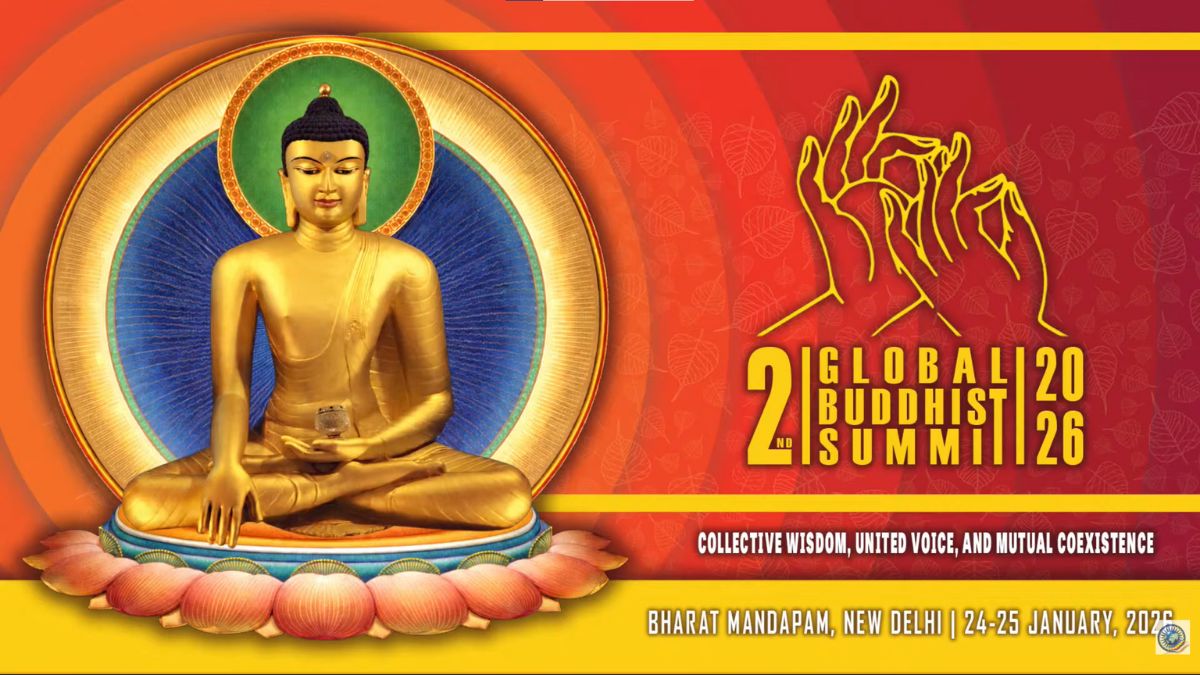
The second Global Buddhist Summit, convened by the International Buddhist Confederation (IBC) in collaboration with the Union Ministry of Culture, began on Saturday at the Bharat Mandapam in New Delhi.
The two-day conference brings together Buddhist leaders, policymakers, and scholars from across the globe under the theme, ‘Collective Wisdom, United Voice, and Mutual Coexistence’.
Moving beyond historical reflection, the summit looks at contemporary global challenges through the lens of Buddha Dhamma.
Reflecting concerns over growing global fragmentation, the opening session examined ‘Collective Wisdom and United Voice for Social Harmony’. This was followed by a second session on ‘Entrepreneurship and Right Livelihood in Buddha Dhamma’.
Speaking at the opening session, the former foreign minister of Thailand, Maris Sangiampongsa, reflected on on how his country served as a bridge between South and Southeast Asia, along with Japan and South Korea.
“Buddhism, in particular, provides a powerful civilisational link between our countries.”
While Orthodox Christianity remains the most widely practised religion in Russia, the country is also home to three Buddhist republics: Buryatia, Tuva, and Kalmykia.
Reflecting on the Soviet period, when state-promoted atheism severely constrained religious practice, Dzgambinov Ochir Vladimirovich, Deputy Head of Government of the Republic of Kalmykia, said that the collapse of the Soviet Union left the region with “almost no functioning monasteries and very few monks".
“However, we managed to preserve our faith,” he said, adding that new monasteries are now being built and that Buddhism has been officially recognised by the Russian government as one of the country’s traditional religions.
In that regard, Chowmna Mein, the deputy chief minister of Arunachal Pradesh, pointed out how both Mahayana and Theravada Buddhism are practised in the state.
“There is no competition, only mutual respect. Both traditions flourish side by side, embedded in daily life and community practice,” he said.
Meanwhile, Daw Nu Mra Zan, Deputy Minister of Religious and Cultural Affairs, Myanmar, underscored the centrality of Pali, noting that the ancient language continues to be extensively studied in the country.
The conversation then steered towards entrepreneurship, where a question emerged: “Can Buddhists amass wealth?”
On the second and final day, the summit will focus on other contemporary issues such as 'Scientific Research', 'Healthcare', 'Medicine and Sustainable Living', 'Learning in the Light of Buddha Dhamma', and 'Sangha Dynamics, Including Roles, Rituals and Practice'.
