



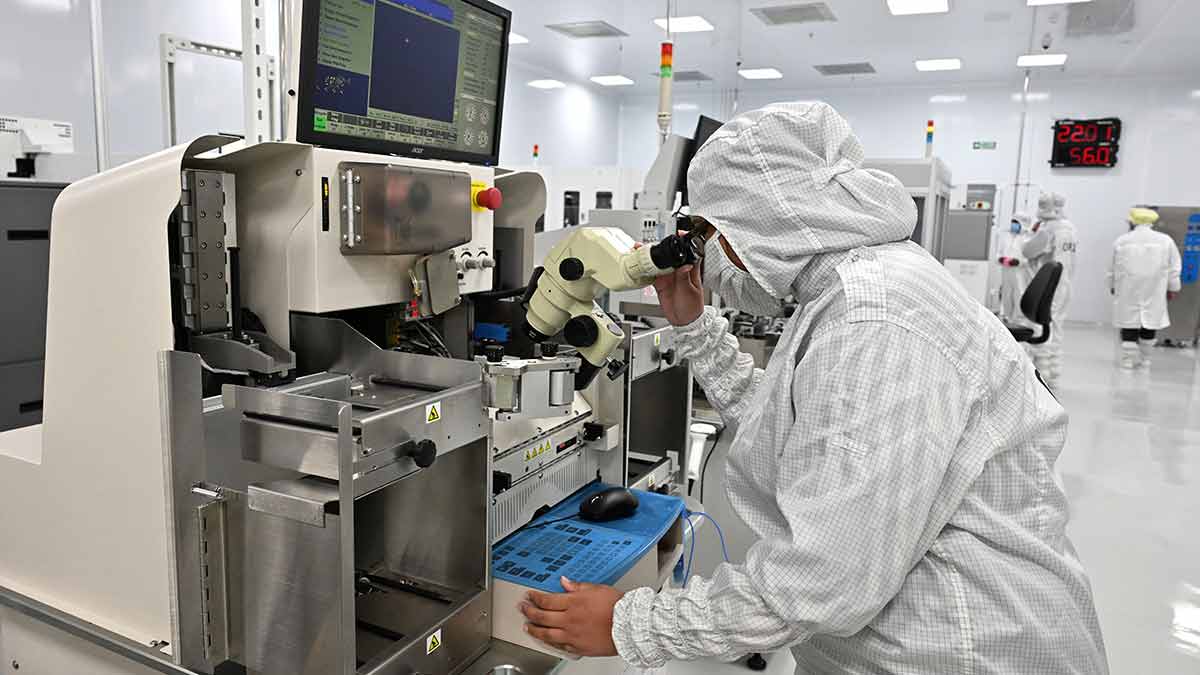
CHIPS AND WAFERS NOW MEAN COMPLEX, inedible things. But they are so central to our lives, aren’t they?
This issue of your favourite newsweekly looks at India’s push to build a semiconductor ecosystem. Senior Assistant Editor K. Sunil Thomas wrote the cover article and Bureau Chief (Delhi) Namrata Biji Ahuja interviewed Union Minister Ashwini Vaishnaw, who handles electronics, in addition to railways, information and broadcasting, and information technology. My sincere thanks to the minister for making time for THE WEEK’s readers.
In addition, Namrata also interviewed Mumin Chen, representative of Taipei Economic and Cultural Centre in India and Ramesh Kunhikannan, executive vice chairman of Kaynes Technology India Ltd. I am sure that the cover article will give you a peek into this world, where India hopes to make a name for itself.
We continue our political coverage of Tamil Nadu and West Bengal, with Special Correspondent Prema Rajaram interviewing Minister Agnimitra Paul on the BJP’s roadmap for the state. Senior Correspondent Shubhangi Shah examines the many concerns of Ladakhis and interviews activist Sonam Wangchuk on the subject.
From across the border, Pakistani journalist Hamid Mir shares the inside story of how his homeland went from being accused of “lies and deceit” by US President Donald Trump to being praised by him for playing peacemaker between Iran and the US. He says that more surprises could be in the offing after Trump’s Beijing visit, and hints at a possible strategic alliance involving Pakistan, Turkey and Saudi Arabia. The article reads like a real-life chessboard, with certain moves visible to us while others are made in the shadows.
Speaking on bonds between countries, Principal Correspondent Abhinav Singh spoke to Biocon executive chairperson Kiran Mazumdar-Shaw about India-Ireland relations, dating back to the freedom struggle. While Shaw has been the honorary consul general of Ireland for south India since 2001, her bond with the country dates back to 1978.
In education, Senior Special Correspondent Kanu Sarda looks at the newer IIMs and how they are holding up against the older and more established institutes. The voices of Directors Neeraj Dwivedi of IIM Kashipur, Ashok Banerjee of IIM Udaipur and Samir K. Srivastava of IIM Amritsar resonate in the article.
In @leisure, among other things, Deputy News Editor Navin J. Antony looks at the future of Hollywood by employing a motif that everyone above 40 will relate to—fungus on video cassettes.
One of the regular columns I love is Scalpen by Dr Mazda Turel. If he had not become a celebrated neurosurgeon, he would have ended up as one of India’s top authors or feature editors. This time, he writes about the insula, the “no man’s land” of the brain. To take us there, he goes through a series of smells. Burnt toast. Cigarette smoke. Petrichor, or simply wet earth after the first rain. And, perfumed talc.
“Anyone with a Parsi grandmother will instantly recognise the fragrance of Yardley London English Lavender Fragrant Beauty Talc,” he writes. And, just like that, we are transported to grandparents and their fragrances.
For me, the smell that instantly takes me to my mother is that of Jabakusum Hair Oil, which she used to order from Calcutta. I think it used to come directly from C.K. Sen & Co., the manufacturers. In our family, the brand had become so deeply linked to her that we buried her with a bottle of her favourite hair oil.
Like her, Jabakusum, too, now lives only in memories, I think. At least, I have not seen one of those red-stickered bottles in a long time.
