




CANADIAN PRIME MINISTER Mark Carney’s speech at the World Economic Forum in Davos has earned him admirers worldwide.
On January 20, Carney said: “Today, I’ll talk about the rupture in the world order, the end of a nice story and the beginning of a brutal reality where geopolitics among the great powers is not subject to any constraints.
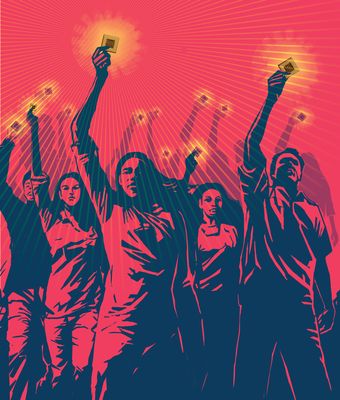 Illustration: Binesh Sreedharan
“But I also submit to you that other countries, particularly middle powers like Canada, are not powerless. They have the capacity to build a new order that embodies our values, like respect for human rights, sustainable development, solidarity, sovereignty and territorial integrity of states. The power of the less powerful begins with honesty.”
Carney spoke about countries hedging against the fickleness and strong-arm tactics of superpowers. He spoke against “transactionalism” and against great powers abandoning “even the pretence of rules and values for the unhindered pursuit of their power and interests”. He said Canada would do what Finnish President Alexander Stubb “has termed ‘values-based realism’ — or, to put another way, we aim to be principled and pragmatic.”
India has been principled and pragmatic in core areas without crowing about it. The Indian National Committee for Space Research was born in 1962 and became ISRO in 1969. Pokhran hosted our first nuclear test in 1974 and then in 1998. This cover of your favourite newsmagazine marks another landmark, when India broke into an elite club of six nations that have made GaN microchips. Properly called gallium nitride monolithic microwave integrated circuits.
These chips are superior to silicon for high-frequency data transmission and have military applications, writes Senior Assistant Editor Sanjib Kr Baruah. After the US, France, Russia, Germany, South Korea and China refused to provide us with the technology, scientists at the DRDO’s Solid State Physics Laboratory developed it independently.
Sanjib interviewed the DRDO’s Suma Varughese, director general of Micro Electronic Devices and Computational Systems and Cyber Security. There are guest columns from accomplished researchers Lt Col Akshat Upadhyay and Gaurav Pande.
We have a standalone guest column by former foreign secretary Vijay Gokhale on why Indo-Pacific states should anticipate greater Chinese assertiveness.
Coming to other articles, I first saw the figurine of a boy in a red vest and tattered blue shorts on Senior Subeditor Nitin S.J. Asariparambil’s office table. But I did not give it a second thought. In this issue, Senior Correspondent Nirmal Jovial brings us the story of how Monkey D. Luffy, a Japanese manga icon, has become a symbol of Gen Z movements from Indonesia to Nepal to Madagascar.
Luffy comes from One Piece by Eiichiro Oda, but he and his band of ‘Straw Hat Pirates’ have an appeal spanning continents. I was wondering if Luffy would pop up in Iran, but there isn’t much coming out of the country, frankly.
THE WEEK Health accompanies this issue, and the cover focuses on the abuse of antibiotics, a problem so common that Prime Minister Narendra Modi addressed it in Mann Ki Baat recently. I am sure middle-aged or younger readers can relate to this imaginary conversation:
“Appa, why did you stop the antibiotics? The course was for five days!”
“I feel alright now, so why take medicines unnecessarily?”
If you know someone who matches the above description, gift them a copy of Health.
