

SENIOR CORRESPONDENT NIRMAL JOVIAL has borrowed Edmund Burke’s words to compress this week’s cover into a sentence: “A state in the guise of a merchant.”
The Anglo-Irish politician and journalist was describing the East India Company (EIC) to the British parliament in the late 1770s, and Nirmal argues that it adequately describes the Big Tech companies that now govern our lives.
Nirmal says if the EIC controlled nearly half of global trade and ruled over 20 crore people—more than any other empire of its time, except Qing China—Big Tech’s sphere of influence and revenue are many times more. It is just that they do it through digital fortresses and data trade. Like the EIC, Big Tech also sees local governments as meddlesome. Hence, this cover story, and let me not give it all away.
Ok, just one more thought from where Nirmal quotes the Greek economist and former minister Yanis Varoufakis. While Nirmal dwells on the economic conversation, I was more interested in how Varoufakis describes his daughter, Xenia, who has now moved to another continent, “a constant absence in my life”.
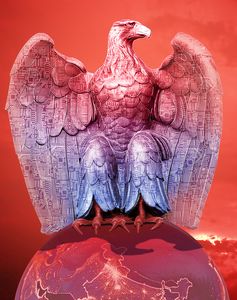 Imaging: Binesh Sreedharan
What a beautiful line to describe something we all have felt. My parents are now a constant absence in my life, though they come back to me in unexpected ways and times. My grandchildren are moving away to study. Some dear friends have passed on. But there are blessings, too. My siblings live within reasonable driving distances, my sons are minutes away, and my daughter is in maddening yet lovable Bengaluru.
That brings me to Principal Correspondent Abhinav Singh’s article on how Bengaluru-based Sarla Aviation, co-founded by German entrepreneur Adrian Schmidt, plans to launch flying taxis in the Garden City by 2027 or 2028. A Bengalurian loses 234 hours a year idling in the city’s congested roads, says Abhinav. I think it might be more.
A combination of factors causes our traffic congestion, I feel, including inadequate infrastructure and selfish driving. For example, in Kochi, there is a mythical phenomenon in the league of ghosts, the Yeti and such. It is called a ‘free left’. People claim that it inhabits traffic junctions, but it is pretty rare to spot one. I feel that surveillance and stiff fines could keep the selfish in line. And then, maybe, we could spot more free lefts.
While technology is said to be the answer for many things, the diamond polishers of Gujarat do not feel so, says Senior Special Correspondent Nachiket Kelkar. Tariffs, automation and the rise of lab-grown diamonds have hit the industry, leading to a steep fall in employment. Even those who have a job are earning comparatively less. As I always say, livelihoods boil down to politicians and policies at the end of the day. And with the world being so interconnected, policies made half a world away could easily turn our lives upside down.
Coming back to the cover and the East India Company, I am sure most of you know that it is now owned by Indian and Indian-origin businessmen. The EIC was dissolved in 1874 and remained dormant for years. In 2005, businessman Sanjiv Mehta bought the brand and revived it. I remember reading around that time that Anand Mahindra and my good friend Yussuf Ali of the Lulu Group had bought stakes in EIC.
Interestingly, among the rights now owned by EIC is the permission to mint coins and print maps and documents originally produced by the company. The company’s site shows that their limited edition 2024 Mohur gold coin is sold out. It was a one tola coin (11.66gm) of 999 purity, the site says. How history comes alive in the right hands!