



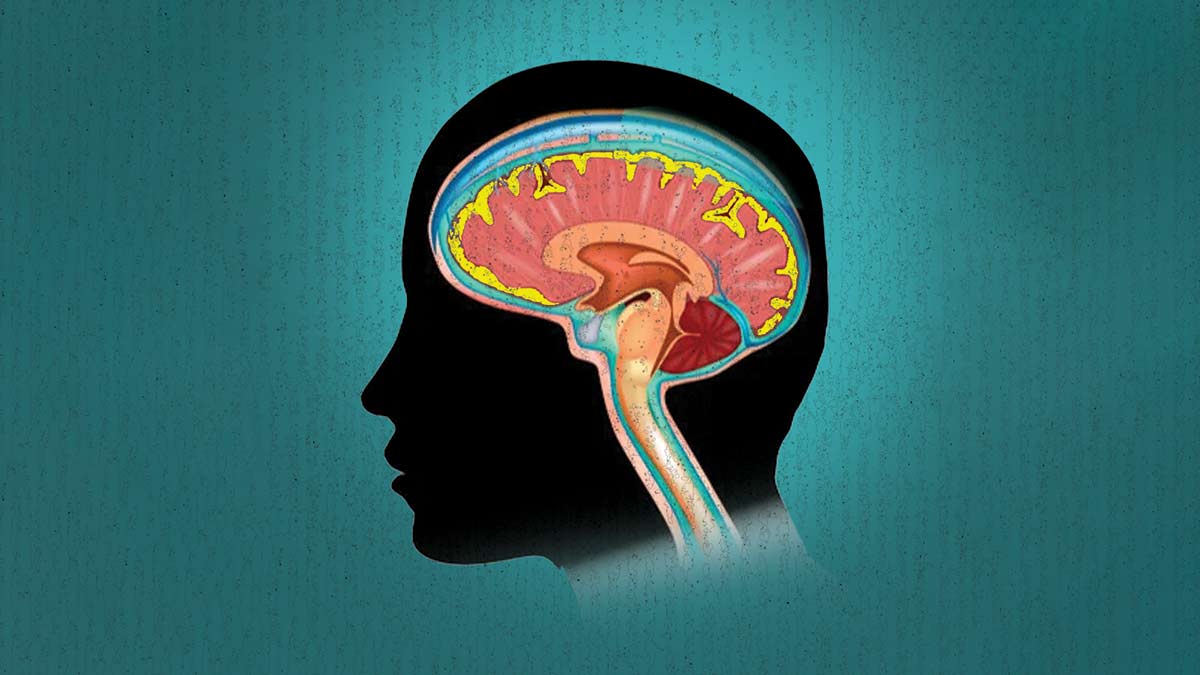
The pia mater is the brain’s most faithful companion. While the dura is its armour and the arachnoid its veil, the pia is its skin—soft, invisible, inseparable. It clings to every fold and groove, following each sulcus and fissure with devotion. You cannot peel it away without peeling away the brain itself. In anatomy class we were told its name is derived from the Latin pia mater, meaning ‘tender mother’. And once you see it, you understand why.
Unlike the dura and arachnoid, the pia is hard to point to on scans or even in the operating theatre. It is so thin that it is almost an idea rather than a structure. It is a suggestion of a boundary, a shimmer on the brain’s surface. Yet it is everywhere, sheltering the cortex, wrapping the cerebellum, cloaking the spinal cord. If the brain is a holy manuscript, the pia is the delicate parchment it is written on.
I was reminded of its quiet loyalty in the case of a young man who came in after a road accident. He had a contusion on his frontal lobe. The brain had slammed against the inside of the skull. On opening the dura, I saw the pia stretched tight over bruised, swollen cortex. It looked like cling film pulled over ripe fruit, translucent yet unyielding, trying its best to hold everything together. When the brain is injured, the pia does not abandon it. It holds on, even when blood seeps beneath it, even when swelling strains it to transparency.
Operating near the pia requires respect. Under the microscope, you see its tiny vessels—capillaries, arterioles, veins—feeding the neurons below. To cut recklessly is to starve a patch of brain of oxygen and thought. The pia reminds the surgeon of restraint. Lift it gently, and it yields; tug at it, and it bleeds in protest. I sometimes think of it as the grandmother in a large family: quiet, easily overlooked, but the one keeping everyone nourished with an unseen hand.
The pia has its share of drama, too. Meningitis—that feared inflammation of the meninges—is in truth often pia-arachnoiditis, the tender mother and her gossamer veil both inflamed, angry and swollen. Subarachnoid haemorrhage eventually irritates the pia as well, coating it in blood and leaving patients with spasms and fevers. And when tumours grow on the surface of the brain, the pia decides the terms of engagement, sometimes letting the surgeon peel the tumour off easily like segments of an orange, while sometimes holding on so tightly that the surgeon must shave tumour from cortex one millimetre at a time.
Patients, of course, never hear about the pia. They ask about tumours and clots, about memory and movement. But I often think the pia deserves its own chapter in the story. It is the silent witness to every thought, every dream, every seizure, every surgery. It is the first to be touched by blood, by infection, by tumour. And yet, because it has no voice, we forget it is there.
An elderly woman I operated on for a convexity meningioma asked me afterward if I had touched her brain. “Gently,” I said. “But before that, I touched its mother.” She looked confused, then amused. “So now two mothers worry about me,” she said.
The pia does not offer easy metaphors of protection like the dura, or of delicacy like the arachnoid. Its poetry lies in intimacy. It is the line between thought and the world, between the mind’s pulsing substance and everything that tries to disturb it. You could call it fragile, but I think tender is more accurate. Fragile things break. Tender things endure.
For surgeons, the pia is both a limit and a lesson. It says, “Go this far, no further.” It asks you to tread softly at the border of consciousness. It teaches you that sometimes the strongest bonds are the least visible.
In the hierarchy of coverings, the pia may be the thinnest, but like so many thin things in life—patience, humour, skin—it’s what holds everything together. And unlike most mothers, the pia will never nag you, although it does bleed when you test its limits.
The author is consultant neurosurgeon at Wockhardt Hospital, Mumbai.
mazdaturel@gmail.com @mazdaturel
