



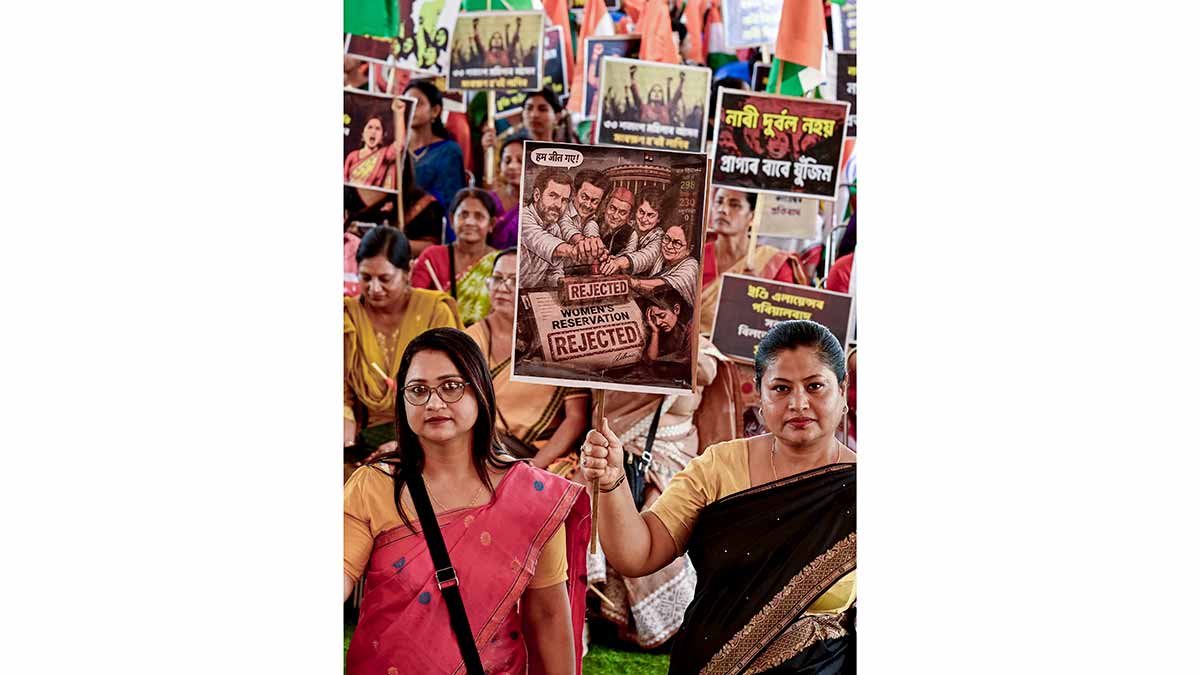
There are moments in a democracy when the intent of political parties stands exposed more clearly than any speech or slogan. The recent parliamentary debate on women’s reservation in the Lok Sabha was one such moment. For decades, meaningful representation for women remained confined to speeches and manifestos, promised often but pursued with little seriousness. When Prime Minister Narendra Modi invited all parties to come together and pass this reform unanimously, it was a call to rise above partisanship and place the interests of India’s women above political calculation. Yet that appeal was met with not statesmanship but shifting objections, revealing an unwillingness to translate rhetoric into reality. What could have been a moment of collective resolve was instead reduced to hesitation, where the search for pretexts took precedence over the responsibility to deliver.
The objections put forward by the Congress and other opposition parties become even more indefensible when viewed against the 2023 constitutional amendment, passed unanimously by all parties. Article 334A of the Constitution mandates that the implementation of women’s reservation shall follow a census and a delimitation exercise. These were the foundation of the framework. To now oppose them is not constitutional fidelity, it is a repudiation of a commitment once made.
The first line of opposition centred on the census and delimitation, framed as procedural concerns but deployed as instruments of delay. A fresh census would have deferred this reform and pushed it into uncertainty. The Modi government’s approach was clear; to rely on the 2011 Census data so that implementation could proceed without delay and the promise of reservation could be realised by 2029.
Delimitation, which became the central point of resistance, is not an administrative choice but a constitutional imperative under Article 334A. Without it, reservation would be structurally flawed, distorting representation and exposing the reform to legal challenge. Redrawing constituencies ensures that reservation is not symbolic but anchored in present demographic realities. To oppose delimitation is, in effect, to oppose the mechanism that makes women’s reservation meaningful. In insisting upon this process, the government ensured that the reform would endure constitutional scrutiny.
The next ground of opposition related to the increase in seats and the supposed imbalance between northern and southern states. This argument, though politically convenient, does not withstand scrutiny especially in light of the assurances given by the home minister. India’s parliamentary framework continues to operate on outdated population benchmarks. In a nation of over 140 crore citizens, expansion of seats is a democratic necessity. To address concerns, the Modi government proposed a uniform 50 per cent increase across all states, ensuring that relative representation remains unchanged. No state stands to lose its voice, and no region gains disproportionate influence. The narrative of regional imbalance, therefore, is less a constitutional concern and more a convenient excuse.
What emerges from this debate is not a difference of opinion, but a difference of intent. On one side stood the Modi government that chose to act, converting decades of deferred promise into a constitutional pathway. On the other stood Congress and other opposition parties that have long spoken of empowerment but stepped back when it demanded the sharing of power.
India’s women have waited long enough. For parties like the Congress, the SP and the DMK, women are voters when ballots are cast, but when power is to be shared, they are met with excuses. History will remember this moment for a simpler truth: when India opened the doors of power to its women, the opposition chose to stand in the doorway and block them.
Bansuri Swaraj is the Lok Sabha member from New Delhi.
