



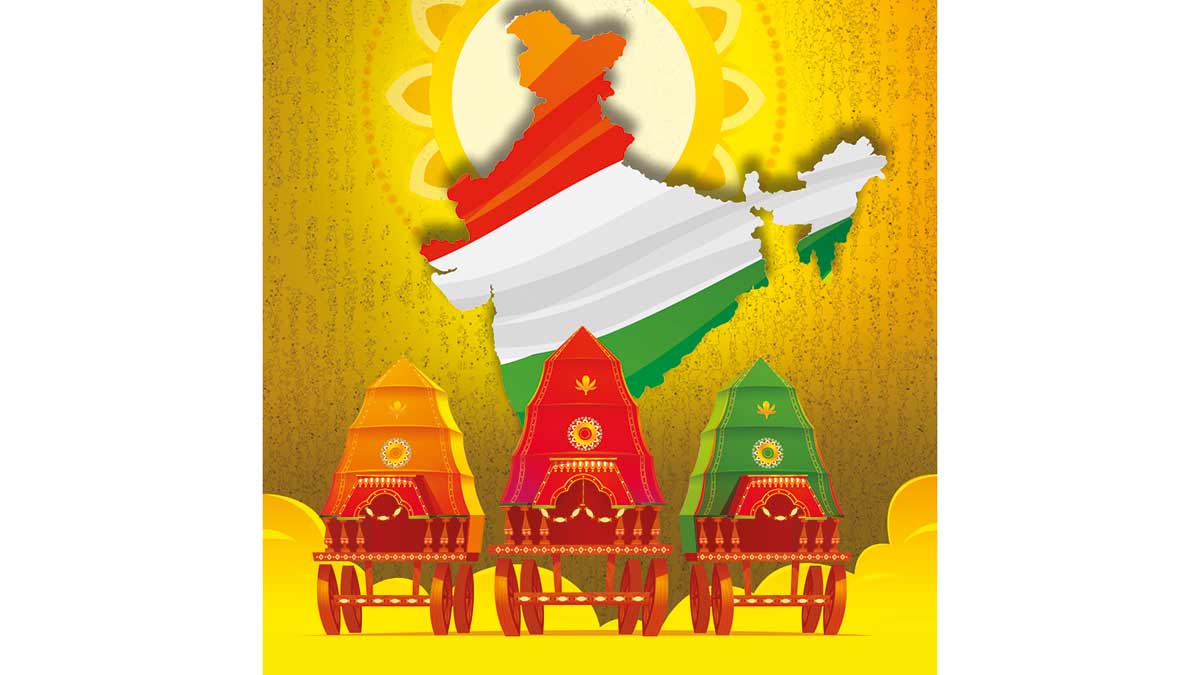
Every year, as the summer yields to the monsoon winds, Bharat prepares for one of its most awe-inspiring traditions—the Jagannath Rath Yatra. While Puri remains the epicentre, this festival transcends geography. I had the privilege of participating in the celebrations this year at Hauz Khas in Delhi, where the spirit of devotion moved not just the chariots, but every heart that had gathered to witness this sacred journey.
The Jagannath Rath Yatra is a vibrant expression of Bharat’s civilisational memory. Lord Jagannath—along with his siblings Balabhadra and Subhadra—leave the sanctum sanctorum of the temple in Puri on grand wooden chariots to meet their mausi maa (maternal aunt), at the Gundicha Temple. For nine days, the Lord steps out from the sanctum and journeys through the streets, accompanied by the chants and prayers of millions. This ritual—rooted in centuries of unbroken tradition—reminds us that the divine in Bharat is never distant. He is among us, accessible and affectionate, guiding without imposing.
As I stood amid the sea of devotees in Hauz Khas, there was a palpable sense of grace in the air. In that divine atmosphere, my thoughts returned again and again to my mother [Sushma Swaraj]. Her relationship with Lord Krishna was not just devotional, it was deeply personal. She turned to Krishna in solitude and in strength, during triumph and during turmoil. Her faith, especially in the Gita’s eternal message of nishkama karma (selfless action) shaped her, both as a public servant and as a person. Whether on the floor of Parliament or across diplomatic borders, her voice carried the calm conviction of someone who saw herself not as powerful, but as accountable, to the people, and to Krishna.
In many ways, Bharat, too, is in a kind of yatra (pilgrimage or procession) today. Not a journey of conquest or spectacle, but of quiet civilisational resurgence. Under the visionary leadership of Prime Minister Narendra Modi, we are witnessing a revival of our sacred spaces and cultural spirit—not in opposition to modernity, but in harmony with it. From the Jagannath Corridor in Puri to the rejuvenation of temples in Ayodhya and Kashi, from digital empowerment to spiritual reawakening, Bharat is rediscovering that her strength lies not in choosing between the ancient and the modern, but in carrying both forward with confidence.
The Lord Jagannath’s chariot moves because many pull it together, and so does a nation. A country as vast and diverse as ours cannot be steered by command alone; it must be moved by conviction, by consensus, by the quiet strength of millions who believe in a shared destiny. The ropes of the chariot are like the threads of democracy, fragile if pulled apart, but unbreakable when held together. Just as the rath rolls forward through unity of purpose, so must our country advance through harmony, effort, and faith in one another.
As the chariot rolled on and the chants of Jai Jagannath echoed into the evening sky, I carried the yatra’s message within me, not as a politician attending an event, but as a daughter walking in the light of her mother’s faith, as a citizen rooted in the soul of this civilisation, and as a public servant reminded that true leadership begins with service. The Lord’s journey is not just a sacred tradition, it is a living call to walk alongside the people, to serve with devotion, and to move forward, together!
Jai Jagannath!
Bansuri Swaraj is Lok Sabha member from New Delhi.
