



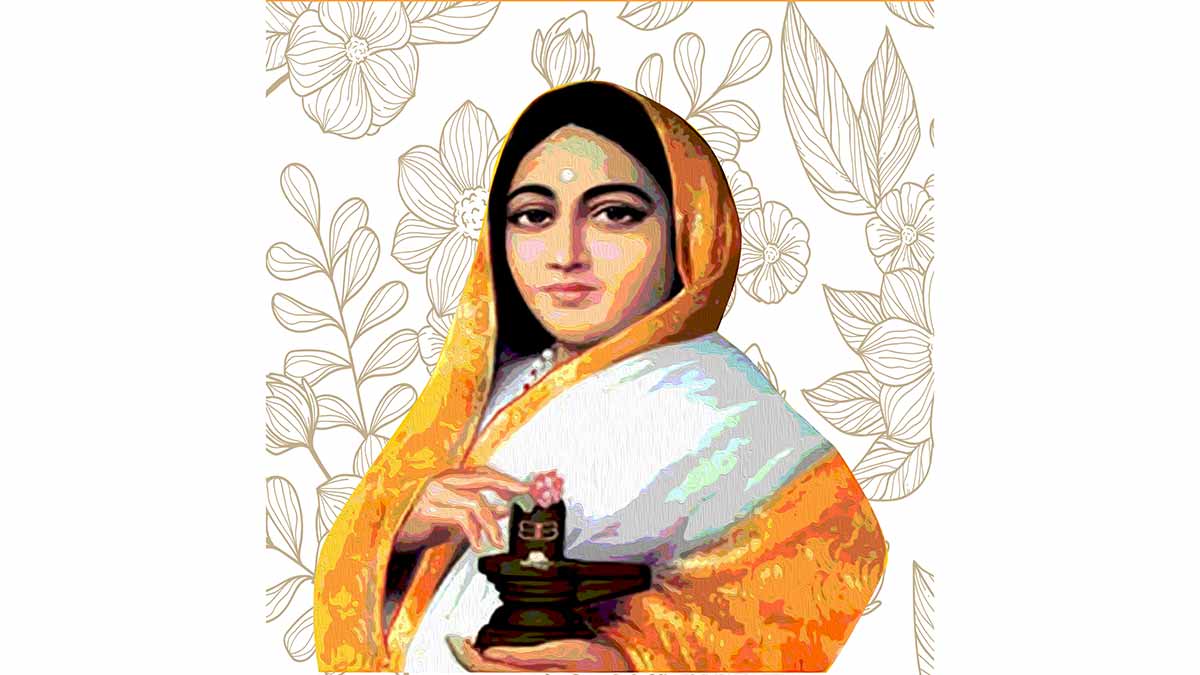
The pages of history are often inked with tales of valour and conquest. Yet, every so often, we encounter a hero whose greatness lies not only in battlefield triumphs, but also in compassion, wisdom and principled governance. A leader whose legacy transcends gender, whose life serves as an enduring ideal for generations to come. Today, I want to tell you the story of Rajmata Ahilyabai Holkar.
Born on May 31, 1725, in Chondi, a village in present-day Maharashtra, Ahilyabai came from modest beginnings. She was married at the age of eight to Khanderao Holkar, the only son of Malhar Rao Holkar, the distinguished subedar of Malwa and a senior commander under the Maratha Peshwas.
Tragedy marked her early adulthood. Her husband fell in the Battle of Kumbher in 1754, and in 1767, she lost her only son Male Rao Holkar, followed shortly by the death of her mentor and father-in-law Malhar Rao. The grief of losing three pillars could have easily broken the strongest of spirits. But from the depths of her loss, Ahilyabai rose with strength and unwavering resolve. With quiet determination, she took up the mantle of leadership and ascended the throne of Malwa in 1767. Her extraordinary reign—marked by justice, compassion, and statecraft—would eventually earn her the reverential title of ‘Rajmata’.
She inherited a throne weighed down by a fractured political order, deep-rooted social divisions, and a region scarred by decades of warfare. But, over the course of the next 28 years, through compassionate governance, unshakeable integrity and an unerring commitment to justice, she transformed Malwa into a flourishing centre of peace, prosperity and cultural revival.
She established an efficient and accessible system of justice, presiding personally over court proceedings to hear petitions from her subjects. Under her leadership, Malwa witnessed the rise of a disciplined and transparent administrative framework, marked by equitable taxation and a deeply welfare-oriented approach. Roads were laid, reservoirs and tanks constructed, and wells dug across towns and villages to ease the burdens of daily life.
Long before the vocabulary of modern feminism emerged, Ahilyabai was quietly laying the foundations for women empowerment through bold and forward-looking reforms. She upheld the rights of widows to inherit property and supported the legal adoption of heirs by women. She established schools for girls, promoted learning, and created safe, inclusive spaces where women could live, work and participate in public life.
The town of Maheshwar, which Ahilyabai chose as her capital, was transformed under her patronage into a vibrant centre of culture, architecture, and craft. Among her most enduring contributions was the establishment of weaving cooperatives, which laid the foundation for the now-iconic Maheshwari saris.
Ahilyabai led one of the most remarkable cultural and spiritual restoration movements in Indian history. Over the course of her reign, she commissioned, rebuilt and restored more than 100 temples across the subcontinent. From the Kashi Vishwanath Temple in Varanasi to Somnath in Gujarat, from Ujjain and Dwarka to Rameshwaram, and even the sacred ghats of Haridwar, her patronage spanned the length and breadth of Bharat. These acts of cultural reclamation ensured that Bharat’s soul could be nurtured through care, reverence and renewal.
The story of Ahilyabai cannot be confined to these few words. But in sharing her journey, my hope is to inspire a deeper remembrance of our true nation builders. Let her memory be not just honoured, but carried forward. Let every girl know her name. Let every woman draw strength from her courage. And let every citizen remember that the foundations of this nation were not only defended by the sword but also built, stone by stone, by the hands of women like her.
Bansuri Swaraj is the Lok Sabha member from New Delhi.
