


Masked in the glory of Kolkata’s cultural heritage are streets that serve as an artists’s canvas—bridging the past and present. Among the most striking examples are the electricity feeder boxes that have been transformed into vivid portraits of icons with roots in the City of Joy—from filmmaker Satyajit Ray and actor Amitabh Bachchan to cricketer Sourav Ganguly and singer Usha Uthup. These everyday artworks, painted over the past decade, now offer passersby glimpses of history and pride.
Behind many of the colourful feeder-box portraits, including standout ones of singer Bappi Lahiri, is artist Ranjit Das. “Bappi Lahiri’s son, wife and mother-in-law came to meet me,” Das says. “I had painted his portrait near Lake Kali Bari. They visited after he passed away.”
Das has painted nearly 400 feeder boxes, and Lahiri’s family remains the only one to have personally met him. Art has been intertwined with his life since childhood, leading him to study fine arts at Bengal Fine Arts College. With over three decades of experience as a commercial artist—painting outdoor signs and political graffiti—Das’s journey has been one of persistence and struggle.
The heart blockages he suffered a few years ago have not stopped him from his pursuit. Living alone in a rented space, he travels by public transport, carrying paint cans in his hand and bag. “An artist’s life is one of pain,” he says. “If there is no pain, one cannot be an artist. You cannot paint without being in a place of pain. But instead of succumbing to pain, you have to remain happy.”
Despite hardships, his work draws attention. Local people, tourists and curious onlookers often stop to watch him paint.
Each project begins with cleaning the feeder box, removing posters and applying primer. Some comments can be discouraging, but Das remains undeterred. Even when completed works are defaced—which does upset him—he returns, restores and moves on to his next canvas.
The feeder-box art movement began in 2015, when an architecture firm in South Kolkata experimented with the concept but eventually abandoned it. Heritage activist Mudar Patheriya revived the idea in 2016 after securing permission from the Calcutta Electric Supply Corporation Limited (CESC). “Graffiti is an expression of Kolkata’s argumentative, articulate nature,” Patheriya says. He selects themes that belong to the neighbourhood. “What is important is to celebrate the locality and the city,” he says.
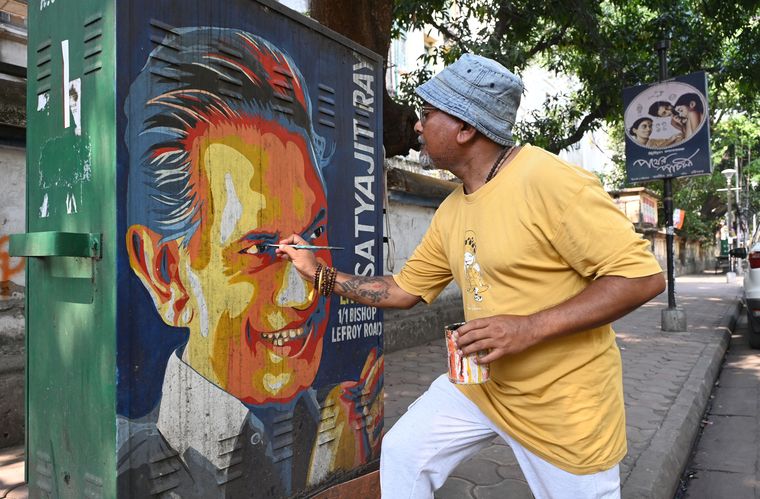 Imagination is electric: Artist Ranjit Das painting a feeder box | Sail Bera
Patheriya conceptualises themes through reading, conversations and research. They are developed into sketches which are then executed by artists like Das. For each feeder box, Das gets Rs2,900. Patheriya says it remains a personal initiative without contributions from others.
Ironically, the project has struck a chord even with people outside Kolkata. “People notice the feeder boxes because they are everywhere. When I introduce myself to people who don’t know me, I say I am the person behind the feeder boxes,” he says.
To Patheriya, Kolkata is a construct of ideas. “Kolkata is not a state of being; it is a state of mind,” he says. “It is liberal, generous and deeply secular. It respects achievers across borders. It is not insular. The construct of the city is a picture of the modern world.”

Beyond feeder boxes, Kolkata’s artistic spirit is reflected in large-scale murals and graffiti. Artist Subhashish Paul, in his early thirties, embodies this energy. During Durga Puja, he painted a towering 40x22ft image of Goddess Durga in just three days and two nights with a small team.
Paul launched his venture, Paul Muralz, in 2020 to provide opportunities for emerging artists. Having faced unpaid work during his student years, he wants to ensure that others do not face the ordeals he endured. “I don’t want any of my juniors to struggle; I want to empower them and give them a platform,” he says.
Paul was inspired by his father, who was a self-taught sculptor. His journey includes formal education at Government Arts College, and early commercial projects. “Whenever I see a blank wall, I feel I should do something,” he says.

Another artist, Sayan Mukherjee, brought life to the entrance wall of the Eden Gardens stadium in 2017, with a colourful graffiti depicting cricket fans. The graffiti was removed in 2023 following ICC World Cup guidelines, but not before it became a popular visual landmark.
Mukherjee’s path includes experience in major advertising firms like O&M and JWT, before launching his independent venture, SayanArt. His projects now span the country—from Damodar Valley Corporation plants and structures in Patna, Sonipat and Daman and Diu to the Andhra Pradesh secretariat.
“Most of my work are government and corporate projects. If the brief is interesting, I like conceptualising and doing the work. If the assignment is straightforward pretty pictures, then it is boring,” he says.
According to Mukherjee, Kolkata influences creativity deeply. “Its lanes are filled with stories, architecture and life,” he says. “The city is old, but it is constantly trying to be young.”
Initiating street art projects can be difficult. Even after securing official permissions, artists often face resistance from local residents. Hence, for some projects such as the ‘Street Art Project’ for Asian Paints, which aimed to showcase 5,300 shades, a large wall in a nondescript lane on Deodar Street in South Kolkata was selected. Mukherjee highlights the complexities involved, from government tenders to working with private companies, all of which require careful planning, attention to artist’s safety and cost management.
“Kolkata influences you a lot creatively,” he says. “If you walk through the lanes of North and South Kolkata, there is so much to see, so many stories to discover. These are fascinating places for inspiration. Friends visiting from outside are amazed by the architecture, culture and people.”
Having grown up in the city, Mukherjee says his artistic sensibilities were shaped by his family and friends. It is also why he chose to begin his commercial venture in Kolkata rather than Bengaluru. His work is notably influenced by the storytelling and typography of Satyajit Ray.
“I was born and brought up here; my family is here,” he says. “If I can make the city beautiful, that is reason enough for me to paint.”
Another artist, Justin, represents a reality of street artists: sustaining a livelihood solely through art remains a challenge. Alongside his full-time job in knowledge process outsourcing (KPO), he dedicates his post-work hours and weekends on projects under the collective ‘Trio’. The three-artist venture began in 2012, when he experimented with spray painting to depict hip-hop culture.
Encouragement from friends kept him motivated, though convincing his parents proved tough. They initially said it was a waste of time, money and energy. However, in his second and third years of college, when he began paying his own tuition fees, they realised that he was serious. His first commercial project was a portrait of Marxist revolutionary Che Guevara.
“After graduating, I spent two years working on commercial projects,” he said. “I realised that this was a field where demand cannot simply be created, even if you are ready to supply.”
Justin remains hopeful of one day pursuing art full-time. “This city has not seen proper art and graffiti,” he says. “We see only political graffiti which doesn’t add cultural value. What is needed is meaningful art work—something that communicates and carries a message to the people.”