
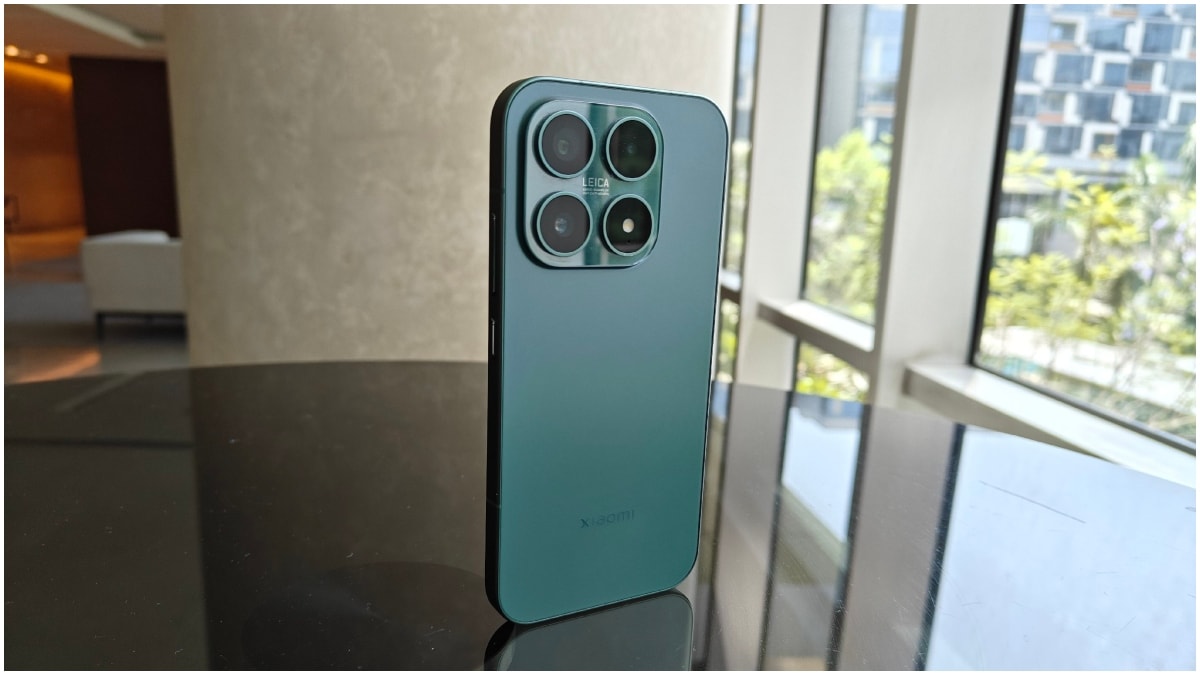
Smartphones with cameras being their biggest USP is not something new. We have been seeing camera-centric devices from the likes of Xiaomi, Vivo, and Oppo for a while now, with Xiaomi's 17 series being the latest addition to that. While the Xiaomi 17 Ultra has been the more talked-about device, I was always more interested in checking the regular Xiaomi 17 — mainly because of that size and design, while not necessarily sacrificing on camera quality.
The device weighs under 200 grams, with curved corners and smooth edges. You get a matte-finish back, with the front having really narrow bezels around the display. The back houses the triple-camera setup, of course, on a rectangular cutout with the Leica branding in its middle. I tried and also preferred the phone in the Venture Green colour, while it is also available in Ice Blue and Black colour options.
The phone has a 6.3-inch (2656x1220) OLED display with up to 120Hz variable refresh rates. It is a really nice display to look at, whether reading text, watching high-resolution videos, or viewing images. It has good viewing angles and can handle HDR content quite well without struggling in dark and contrasty scenes.
Coming to the camera performance, the phone features a 50MP (f/1.67) main camera, a 50MP (f/2.0) telephoto camera, and a 50MP (f/2.4) ultra-wide camera — all tuned in partnership with Leica. I generally found the camera to be a reliable point-and-shooter; of course, there are dozens of Pro settings you can choose, and those do come in handy, such as the Leica Authentic style, but what is also nice is not always having to tinker before taking a shot. Photos came out detailed with good colour reproduction and dynamic range in pretty much every type of scene. The only thing in the camera department that does not quite shine is the performance of the telephoto lens — they could have gone better than 2.6x optical zoom, but it is certainly not a deal-breaker. The front-facing 50MP (f/2.2) camera takes sharp and quick shots, and I found its contrast better than the 15 series that I can remember. You can shoot 4K at 60fps from both front and rear cameras, and with Dolby Vision from the rear camera, too.
The device is equipped with Qualcomm's Snapdragon 8 Elite Gen 5 chipset (up to 4.6GHz octa-core processor, Adreno 840 GPU, and X80 5G modem) along with 12GB of LPDDR5X RAM and 512GB UFS 4.1 internal storage. It is running on Android 16-based HyperOS 3.0 with the March security patch installed. The device is not short on performance by any means. Day-to-day tasks work smoothly, with no stuttering or lags seen. You can play heavy games like BGMI at the highest settings and high frame rates, though playing something like Genshin Impact for over half an hour did make the phone heat up a bit. Otherwise, the phone did not show signs of heating. I wish Xiaomi would add notification history to HyperOS; I am not sure why that is still missing.
What is not missing is more than a day's battery life with its 6,330 mAh silicon-carbon battery. The phone lasted me over a day almost on every single charge. You get a 100-watt charger in the box, and the phone can be charged from 1% to full in a little over an hour.
Wi-Fi and Bluetooth performance on the phone is top-notch. I also liked its 5G network reception for working on the go over a Wi-Fi hotspot. The loudspeakers, though, are only okay, in my opinion. They have decent loudness but very little depth; for watching videos and playing games, you expect better from Xiaomi in this regard.
At ₹89,999 (currently for the 512GB variant), you can argue the phone is priced quite a bit higher than usual from the house of Xiaomi. Given memory chip pricing increases and their effects on multiple industries, including phones, it is not exactly surprising. The Xiaomi 17 does come across as a well-rounded smartphone with very little not working in its favour. I would definitely pick it over the regular Samsung Galaxy S26, while it is a closer battle against the Vivo X300, with personal preference being more relevant there in terms of design and software.