



The conversation around children’s mental health cannot begin and end with identifying problems. It has to start much earlier—with parents and teachers creating spaces where children feel safe enough to speak.
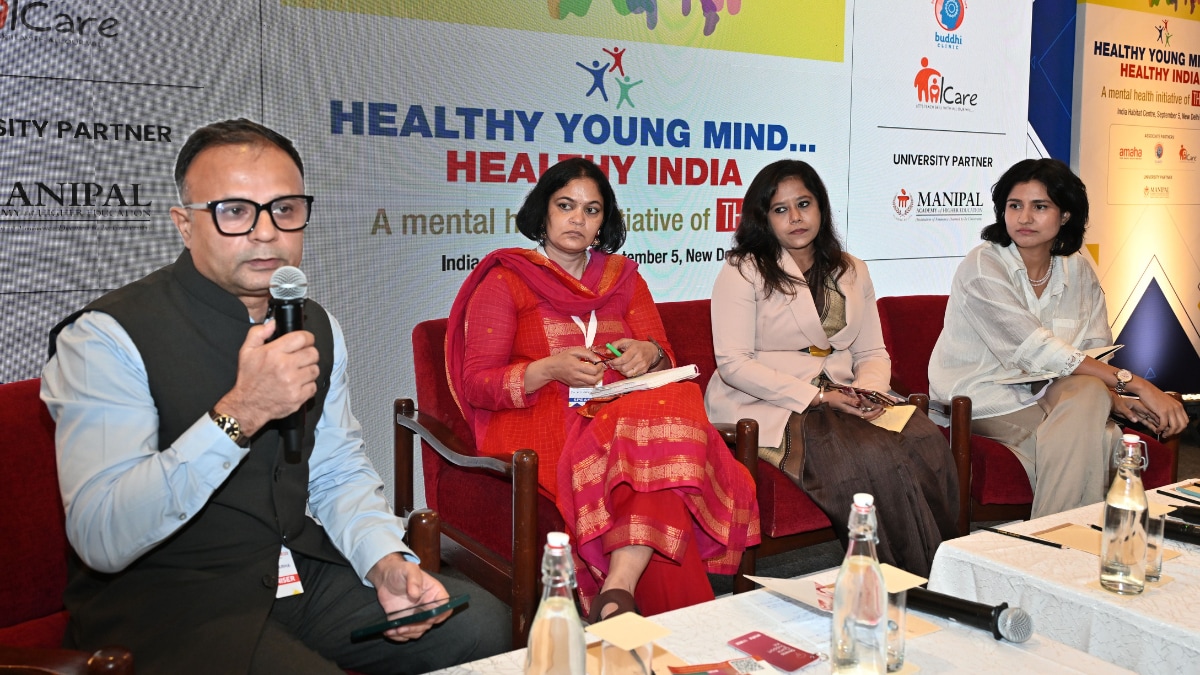
That was the central message at the panel discussion, 'Where the change needs to start', at THE WEEK’s ‘Healthy Young Mind, Healthy India’ event.
The panel featured Dr K.S. Meena, Professor and Head of the Department of Mental Health Education at NIMHANS; Kalpana D. Kumar, Founder and Director of KARE Therapy Center, Chennai; and Lavina Nanda, Head of Developmental Services at Children First. The session was moderated by Pratul Sharma, Senior Assistant Editor, THE WEEK.
Dr Meena said one of the first challenges is the inability of parents and teachers to recognise when a child is struggling. Often, concerns are dismissed as a passing phase and “brushed under the carpet”. Instead, adults need to understand where a child’s behaviour is coming from, rather than immediately judging it.
“It is important for teachers and parents to allow children to share when they don’t feel safe,” he said, stressing that trust is central to any meaningful conversation about mental health.
While parents understandably want their children to trust them and talk about their emotions, Dr Meena also cautioned against excessive monitoring without consent. Constant surveillance, he suggested, can itself become part of the problem if children feel that their privacy and autonomy are not respected.
Kalpana D. Kumar argued that schools need to do more to normalise conversations around difficult subjects. How many parents, she asked, actually speak to their children about issues such as drug abuse and sexual abuse? She noted that the answer is very few.
She also stressed the need to distinguish between stress and trauma, particularly as children enter adolescence. As teenagers grow, they begin developing a stronger understanding of what is good or bad for them. Parents and schools need to recognise this evolving autonomy and educate themselves about the mental health issues that need to be discussed openly.
The education system, Kumar said, also needs to recognise that children possess different strengths and abilities.
“All animals have their own strengths, multiple intelligence,” she said, arguing that the education system needs to “wake up” to this diversity rather than expect every child to fit the same mould.
For Lavina Nanda, listening means much more than simply hearing what a child says. It requires paying attention to the child’s entire behaviour and body language—whether they appear to be hiding something, withdrawing, or struggling to express themselves.
However, she cautioned parents and teachers against turning themselves into detectives. The objective, she said, should not be to interrogate a child but to understand what they may be experiencing.
Instead of immediately asking what went wrong or what should have been done differently, Nanda suggested beginning with empathy: How must this have felt? How are you holding up?
She also emphasised that adults cannot expect children to possess the same emotional regulation capacity as adults. Emotional cognition and maturity are still developing during adolescence. Children therefore need “equity”, patience and the understanding that their ability to process emotions is still evolving.
The panel’s message was clear: meaningful change in children’s mental health must begin not with more surveillance or judgement, but with safer conversations, greater empathy, and adults willing to listen before they react.
The challenge, however, is not limited to the spaces children inhabit at home and in school. Their mental well-being is also being shaped by an increasingly hyperconnected digital environment.
Speaking during the session 'Mind on scroll: Social media & young minds', Dr Abhishek Banga of the Department of Women and Child Development said that the constant stream of information and notifications from morning to night is fundamentally altering the way young people pay attention.
“When you scroll through social media, one feed leads to another, and you move rapidly from one piece of content to the next,” Banga said. While users may appear to be constantly attentive to these “micro-fluctuations”, their overall attention span can gradually decline. In that sense, he said, “social media is essentially snatching away our attention".
The problem, Banga suggested, goes beyond attention. Social media can also become a way of coping with stress, but the relief it offers is temporary. Scrolling may distract a person from what is troubling them, but the moment they step away from the screen, the underlying stress can return.
“So, while scrolling may provide temporary relief, it does not really address the underlying stress,” he pointed out.
His remarks add another dimension to the discussion on children’s mental health: helping young people get “back on track” may require not only more empathetic parents and teachers, but also a closer examination of the digital environments that increasingly compete for their attention.
