



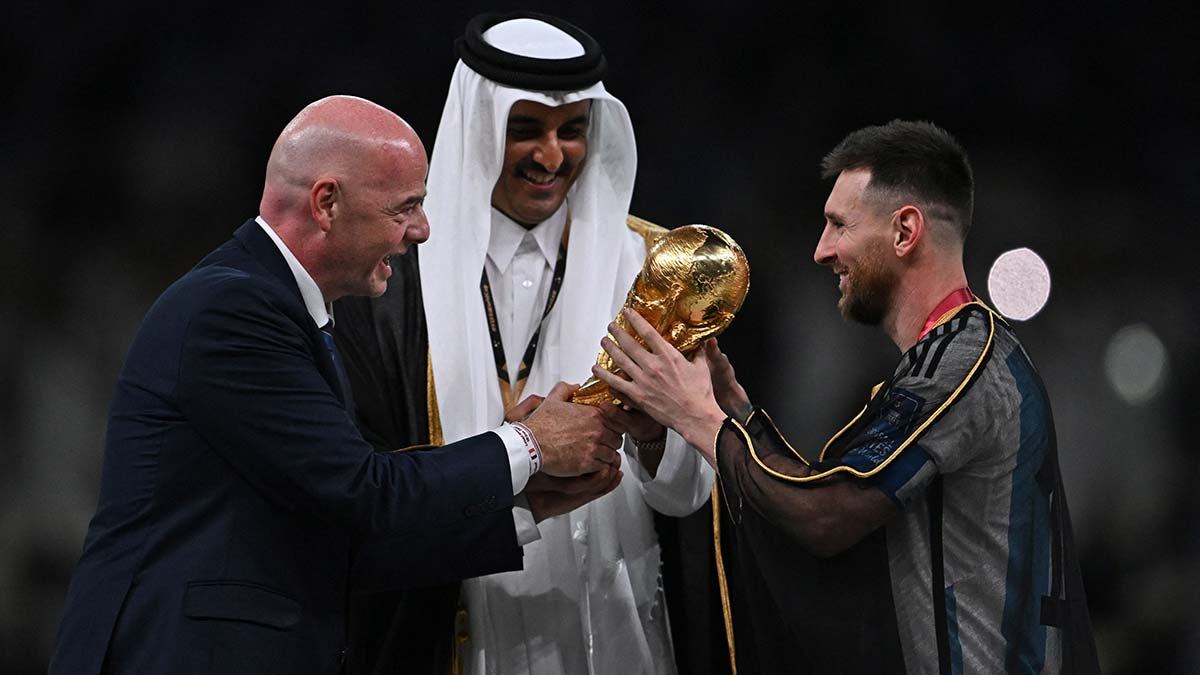
Messi magic
In Argentina’s tournament opener against Algeria, the GOAT stamped his authority on to Aissa Mandi’s calf, holding up his hands the whole time. He escaped without even a yellow card.

But then US star striker Folarin Balogun saw red for a foul strikingly similar to Messi’s. This was followed by some dodgy refereeing in Argentina’s round of 16 clash with Egypt, where the former stormed back with three goals in under 15 minutes to knock Egypt out. The anti-Argentina squad and even many neutrals could no longer contain themselves—the World Cup is rigged to ensure Argentina win, they concluded.
This was not a first. Both players and coaches have in the past raged about the alleged Messi bias. Dutch coach Louis van Gaal said the 2022 World Cup was rigged to ensure that Messi won. Chilean midfielder Arturo Vidal, who would later join Messi at Barcelona, once alleged there was a different set of rules for the legend. But his ire was directed at what he felt was FIFA’s special treatment of its multi-billion dollar asset.
Like father, like son
At least 14 men at this World Cup have a parent who played football at a respectable level. And most of them have done their dads proud. While Sweden’s Anthony Elanga—son of former Cameroon defender Joseph Elanga—scored two brilliant goals, superstar Erling Haaland used the stage to pay tribute to both parents—Alf-Inge Haaland and Gry Marita Braut (former heptathlete)—by adding Braut to his jersey.
Dutchman Justin Kluivert also paid a tribute, just not a good one. His father, Patrick Kluivert, a world-class striker in his time, had missed a penalty on June 29 at Euro 2000. On June 29, 2026, Justin did the same. Incredibly, both shots hit the bottom right of the goal frame.
Patrick, who missed in regulation time, made up by scoring in the shoot-out. Justin, 27, would have to wait.
Visionary solution
As the first half of Japan’s 2-2 draw with the Netherlands was coming to a close, the Japanese were glancing around for a clock. But at the AT&T Stadium in Texas, the screen suspended above the pitch is difficult to see for the players. This forced the Japanese dugout to think on their feet; manager Hajime Moriyasu held up whiteboards with numbers scrawled on. This becomes particularly significant when we consider that the team got its timing just right, scoring its second goal to equalise for a second time with 88 minutes on the clock.
The invisible 9
The false 9 is not for everyone. The role requires tactical intelligence across the team and the ability to sustain build-up play. Spain have both in abundance.
So, while lesser teams struggle to play with a false 9, Spain debuted the next evolution: the invisible 9. Real Sociedad captain Mikel Oyarzabal played the role to perfection against Cape Verde in Spain’s tournament opener—he was the first player to go half an hour without touching the ball since the metric was introduced in 1966. As it turned out, it was a one-match special. He returned to scoring in the next match.
Meet the Bindons
Kiwi Tyler Bindon’s cameo against Iran was short but historic. His mother, Jenny, was New Zealand’s goalkeeper at two World Cups (2007 and 2011), which made them the first mother-son duo to feature at the tournament.
US-born Jenny met husband Grant at university. After they moved to New Zealand, Grant captained the national volleyball team, while Jenny guarded the net for the football team. A young Tyler was a constant presence during her training—she told teams that he would have to come along as she didn’t have childcare. All that exposure to professional football came in handy. Tyler, 21, is with Premier League club Nottingham Forest and spent last season on loan to Sheffield United, making 22 starts in England’s ultra-competitive second tier.
Sons of a Goan father
On June 15, Maximilano Araujo scored Uruguay’s equaliser against Saudi Arabia in their tournament opener. The next day, Indian publications screamed of his Goan origin. Apparently, his grandfather Redualdo Araujo was from Loutolim. Football journalists shrank in their shoes at having missed the news. Soon, it emerged that the connection was manufactured—it was a prank by a young Goan with the surname Araujo.
But there was indeed a Goa connection. The bishop of Cape Verde, Dom Jose Colaco, was originally from Margao, and he once returned to Goa to take along some priests for a mission to the island nation. One of them was Fr Caetano Francisco Piedade Pimenta Pereira, who would go on to spend five decades in Cape Verde, building 40 chapels. His impact was so great that the country’s largest avenue—the Padre Pimenta Avenida in the capital Praia on Santiago island—is named after him.
The Nestory story
In May 2024, an 18-year-old winger at Adelaide United was asked if he expected to break into the Socceroos squad soon. His answer: “I’m still eligible for Tanzania. Burundi as well.” Nestory Irankunda wasn’t bluffing. Born in a refugee camp in Kigoma, Tanzania, to Burundian parents who had fled the civil war, he held three passports’ worth of options, and Football Australia knew it.
The threat worked. Within weeks he was capped, and five days after his debut he scored a penalty against Palestine that made him, at 18 years and 123 days, the second-youngest scorer in the country’s history.
At his debut World Cup, he scored against Turkey to become the youngest player to score for Australia at the World Cup, as well as the first born abroad. He celebrated with the corner-flag punch of Socceroos legend Tim Cahill, showing that his football identity was very much Australian.
The fall woman
Before she was the woman who wrongly announced Jorge Messi’s death, Florencia Pena was one of Argentine television’s most enduring names. She was best known for her role as Moni Argento—the exaggeratedly made-up housewife of Casados con Hijos (a remake of American soap Married... with Children).
Her second act, hosting Luzu TV’s El Show del Verano (The Summer Show), ended in 14 words: “I don’t want to bring bad news, but Messi’s father has just passed away.” The news, she later insisted, was fed to her by the show’s producers. Pena repeated it, then within moments walked it back.
According to her lawyer, a crying Pena called the Messi family the second the broadcast ended and could barely get a sentence out.
Initial reports said she had “decided to step aside”, but her legal team maintains the exit was not voluntary. She apparently thought about suing the channel for 750 million pesos (about Rs5 crore), but with some mediation, decided against it.
Brothers from another father
When Ivory Coast beat France in a friendly ahead of the World Cup, the African team’s right-back Guela Doue scored the equaliser. His younger brother, French winger Desire, watched on from the bench. At this World Cup, Desire scored in the 4-1 win against Norway. If Guela had also scored, they would have become the first brothers to score for different countries at a World Cup.
But that record is no longer up for grabs. Just a day after Desire scored, Ghana’s Derrick Luckassen netted against Croatia. His half-brother, Brian Brobbey, had already scored for the Netherlands. Luckassen played for the Dutch till the under-21 level before switching allegiance to their mother’s country.
The left-leaning goalie
When a team makes its World Cup debut, it is an unforgettable occasion for the players. For Jordan’s goalkeeper Yazeed Abulaila, it was one to forget. After conceding five goals in his first two matches, he slipped up once again in the most high-profile match of his life. Argentina beat Jordan 3-1, but it was Abulaila’s movements that caught the eye. Defending a free kick, he inexplicably skipped twice to the left, letting Giovani Lo Celso stroke the ball into the other side of the goal. For the second goal—a Lautaro Martinez penalty—he dived left early. To be fair, many keepers do that. But then, with substitute Messi over a free-kick, Abulaila skipped twice to the left once more. Perhaps he was trying a create a better angle to watch from as Messi passed the ball into the net.
Lots of love
Seven saves into the World Cup, Vozinha was sad. Even Cape Verde’s heroic draw against Spain couldn’t cheer him up. The reason: his mother, Ana Candida Evora, was not there to see it. Cape Verde is among the countries whose citizens face a US visa bond of up to $15,000—refundable, but enough to keep most families home.
The bond could be waived for players’ relatives. The State Department said as much, and noted it had no record of Evora ever applying. It was probably a dream too big for the family. It took House Minority Leader Hakeem Jeffries, who called Secretary of State Marco Rubio to get it done. “No mother should miss the chance to see her child make history,” Jeffries said.
Evora landed in Miami after more than 24 hours in transit and watched her son from a suite as Cape Verde drew Uruguay 2-2.
Vozinha’s impact went beyond the pitch, too—a Spanish biologist named a newly discovered species of sea nail in his honour. The bright red mollusc is called Aldisa vozinha.
Long in the foot
Across the previous 22 World Cups, there were only seven players north of 40. In 2026 alone, the figure reached eight. The names included Cristiano Ronaldo, Luka Modric and Bosnia and Herzegovina’s Edin Dzeko.
None of them, however, beats Egypt goalkeeper Essam El Hadary, who played in the 2018 edition at 45 years and five months—the oldest player to do so.
In Dzeko’s case, at least two of his teammates were younger than his illustrious career across the Big Five leagues. All of the ‘Elixir Eight’, apart from Scotland goalkeeper Craig Gordon, got some minutes on the field. Ronaldo even got three goals. And, with improving sports science, don’t be surprised if you see more than eight oldies in 2030.
The Wall of Persia
Unlike Jordan’s Abulaila, Iran’s Alireza Beiranvand had a World Cup to remember. Born in September 1992 into a nomadic Kurdish Lak family, he herded sheep as a boy and played dal paran, a game of throwing stones over long distances. It helped build his trademark arm strength—he holds world records for the longest throw in football (61.002m) and the longest drop kick (78.014m).
The man now known as ‘The Wall of Persia’ had to run away from his family as a boy to chase football. He got to Tehran with no money and no contacts. He slept on streets outside football clubs and did odd jobs like washing cars, sweeping streets and preparing dough at a late-night pizza shop.
Cut to 2026, and Beiranvand made seven saves to hold Belgium to a 0-0 draw, earning player of the match. The 33-year-old played every minute of the campaign as Iran finished unbeaten, but were narrowly pipped to a round of 32 spot by Senegal, whom Belgium then eliminated.
Publicity via FIFA
Cosmic Charlies, a cannabis dispensary in Toronto, got into the World Cup spirit with a bong in the shape of the trophy. It wasn’t long before FIFA sent a cease-and-desist letter, accusing the dispensary of “advertising, offering for sale and/or selling products bearing the FIFA trademarks”. The brothers who co-own the shop promptly filmed themselves destroying the trophy. “I poked the bear,” said co-owner Sean Kady. “I guess it was to be expected.”
Before the World Cup kicked off, he had hoped that FIFA would come for him and said he would frame any letter he received. However, the letter turned out to be five pages long and outlined eight immediate demands, including turning over receipts, marketing material and information on how many of the $50 bongs were sold. Kady said he only had two and one was sold—apparently to someone who didn’t even smoke pot.
Borrowed grass
There were complaints about the pitch at MetLife Stadium at last year’s Club World Cup. That was a problem as it was to be the venue for the 2026 World Cup final. So, FIFA swung into action. New Jersey-based Tuckahoe Turf Farms was meant to supply the grass, but a brutal winter buried that field under snow. FIFA, which had grown surplus grass across 11 farms in the US, Mexico and Canada, redirected roughly 20 truckloads north from Carolina Green Turf Farm.
What awaited that grass wasn’t a lawn so much as a construction site. The artificial turf had been stripped out, replaced by two feet of sand containing a full irrigation network and a vacuum ventilation system with HVAC (heating, ventilation and air conditioning) units to pump warm air in the cold and cool air in the heat to regulate growth. A stitching machine later sewed the individual sections into a single field. It was a marvel.
But, if FIFA expected praise, it would be disappointed. France’s Adrien Rabiot said it was “hard and rigid”, while Vinicius Junior complained that the grass drying out strangled Brazil’s rhythm.
The legacy continues
Any true Brazilian fan would remember the affable Clovis Acosta Fernandes in the stands, with his signature white walrus moustache and a replica of the World Cup trophy in his hands. He cheered for the Selecao at seven World Cups and attended more than 160 Brazil matches. The picture of him weeping after Germany’s brutal 7-1 rout of Brazil in 2014 is frozen in time. An emotional Clovis handed over the replica to a German fan after the match. It was his last World Cup; he died the next year after a long fight against cancer. His sons, Frank and Gustavo, now carry on his legacy, and the former was seen in the stands at this World Cup.
Gen Z flair
When the veterans are running riot, how can Gen Z fall behind? Lamine Yamal and Pau Cubarsi made history by becoming the first teenage pair to start in a World Cup knockout match since Pele and José Altafini did so for Brazil in 1958. Endrick and Rayan became the first teenage pair to share the pitch for Brazil in 68 years. However, as the Norway game showed, perhaps the shoes were too big for them to fill.
The youngest player of the tournament was Mexico’s Gilberto Mora, who entered aged 17 years and 240 days—only a year older than Cristiano Ronaldo Jr.
Men of the patch
Trust FIFA to be a killjoy. It introduced exclusive milestone sleeve patches on jerseys and the gold World Cup patch for the seven former winners at this year’s tournament. They included: World Cup debut, golden ball, golden boot, golden glove and the Match 1000 (for Japan vs Tunisia). Lionel Messi, Luka Modric and Manuel Neuer got to wear multiple patches.
The dampener? Once the matches ended, the milestone patches were peeled from the jerseys and embedded into a limited-edition series of Topps trading cards, which are set to go on sale for the public only from 2031. Another World Cup would be done and dusted by then. Logic, anybody?
No Real in Spain
Paris Saint-Germain were the most successful team in the 2022 World Cup with 18 goals. Four years later, Real Madrid led with 19 ahead of the semifinals—the most by one club’s players at a World Cup. The common factor? Kylian Mbappe. While five Real Madrid players made it to the semifinals, including new signings Ibrahima Konate and Marc Cucurella, the goals have mostly come from Mbappe (8) and Jude Bellingham (6).
For Real Madrid, this scoring spree should be extra sweet, given that they were previously trolled for failing to contribute even one player to the Spanish squad at this World Cup. Cucurella was signed during the tournament. Arch-rivals Barcelona had eight players in the squad, but the Catalans have scored just once in the tournament so far, courtesy poster boy Lamine Yamal.
Free and fierce
One of the most infamous videos in football history shows a defender charging out of the wall to boot the ball away before the opponents could take a free-kick. It was so bizarre that it seemed like he did not know the rules. The truth, however, is much darker.
Zaire Dictator Mobutu Sese Seko had given all his players a house and a car after they became the first Sub-Saharan African side to reach the World Cup, in 1974. But the gratitude curdled fast. After a 2-0 opening loss to Scotland, he withheld the bonuses, and the players responded by capitulating 9-0 to Yugoslavia. Before the final group match, Mobutu delivered an ultimatum—lose by more than three goals and don’t bother coming home. Zaire held out for a 3-0 loss to Brazil. The free-kick away by Mwepu Ilunga was part of that effort.
Fifty-two years later, DR Congo—renamed after Mobutu’s 1997 overthrow—returned to the World Cup and made the Round of 32, where they pushed England hard before a 2-1 defeat. This, time though, the motivating factor was not survival, but legacy.
Seeing red
It isn’t easy playing at an elevation of 2,241m. Ask England’s Jarell Quansah, whose sliding tackle on Mexico’s Jesus Gallardo at the Azteca Stadium got him a two-game ban. The Azteca accounted for five of the 14 red cards in the tournament till the semifinals. Perhaps the thin air messed with the players’ heads.
There was plenty of air in Kansas City, but that didn’t stop Switzerland’s Breel Embolo from getting a second yellow for simulation. It was a controversial decision and the opposition was Argentina.
Interestingly, the men in white and blue were wearing a black armband to mourn the passing of Antonio Rattin. Why does he matter? Well, during the 1966 World Cup, Rattin refused to leave the field claiming that he didn’t understand the German referee’s orders. Later, Rattin would reveal that he and his coach planned it in case the German referee was favouring his English friends. The episode, importantly, led to the introduction of the current card system.
Out in the open
Some rules take years before anyone falls foul of them. However, FIFA’s new rule—confrontations with closed mouths could attract a straight red—barely needed a week. Latin Americans Miguel Almiron and Piero Hincapie (in pic) perhaps weren’t familiar with the rule or just forgot. Their opponents were quick to alert the referee of the rule break, speeding up their exits.
FIFA established the rule to prevent players from hiding abusive, discriminatory or offensive language on the field. It is nicknamed the ‘Prestianni Law’, after Benfica winger Gianluca Prestianni, who pulled his jersey over his mouth to hide verbal insults toward Vinicius Junior during a Champions League match.
Active volcano
The Guadalajara Stadium—one of three Mexican venues for the World Cup—looks like it sprouted from the earth. Built inside a grass-covered, man-made hill, it was designed to look like a volcano. The white roof, which looks like its floating, resembles a cloud of smoke hovering above the volcano. This was intentional. When thousands of fans roar and jump together, the stadium feels like a volcano erupting with human energy.
Guadalajara is also known for the authentic, blue agave-based tequila. It wouldn’t be surprising if the French engineers had two shots too many while brainstorming the design.
Expensive exit
Fernando Muslera was supposed to be the safe option. Uruguay coach Marcelo Bielsa had coaxed the national hero out of retirement at 40, betting on his strong club form. Instead, the veteran became the first goalkeeper to commit three errors leading to goals in recorded World Cup history. After his mistake against Spain in the final group match, he even asked to be substituted. Sure enough, Uruguay became the only South American side eliminated in the group stage. The intensity of Bielsa’s methods had led to a mini mutiny during the tournament. The coach closed it out with: “What do I leave for Uruguayan soccer? Nothing.”
The federation’s response to it all was to cancel the team’s chartered flight home. Players who had expected a private jet back to Montevideo were instead left to book their own commercial tickets—some to Uruguay, others back to their clubs.
A grave mistake
Assim Madibo’s late challenge on Canada’s Ismael Kone, during the co-host’s 6-0 win over Qatar, broke both his tibia and fibula. Kone, 24, had been Canada’s most important player because of the injury to talisman Alphonso Davies. Madibo, horror on his face at what he had done, got a straight red and then a five-game ban. He apologised in Canada’s dressing room and later visited Kone in hospital with Qatar’s sports minister. Photographs showed the two embracing, Kone in a wheelchair. Apparently, the Canadian could miss most of next season.
Sins of the father
Goalkeeper Ahmed Shobeir’s most famous save was time. In Egypt’s goalless draw with Ireland in the 1990 World Cup, his teammates passed back to him over and over. He gathered the ball and held it to run down the clock, a tactic widely credited with forcing FIFA’s hand on the back-pass rule.
Thirty-six years later, with Egypt up 1-0 against Argentina in the round of 16, his son, Mostafa, saved a Messi penalty and produced a brilliant parry to deny Julian Alvarez from close range before half-time. Egypt doubled their lead through Mostafa Zico in the 67th minute. From there, the only tactic was seeing out the remaining minutes. But Mostafa could not waste time—the most recent iteration of the change his father had forced sees an eight-second limit for keepers to release the ball, failing which the opposition gets a corner.
