



Any idea how the Eurofighter Typhoon is made? Britain builds the front fuselage, Spain makes one wing, Italy makes the other wing and the rear fuselage, and Germany the centre fuselage and final assembly. Air forces of all four are flying the plane in various numbers; the countries are together selling it to other countries, and are sharing the profit.
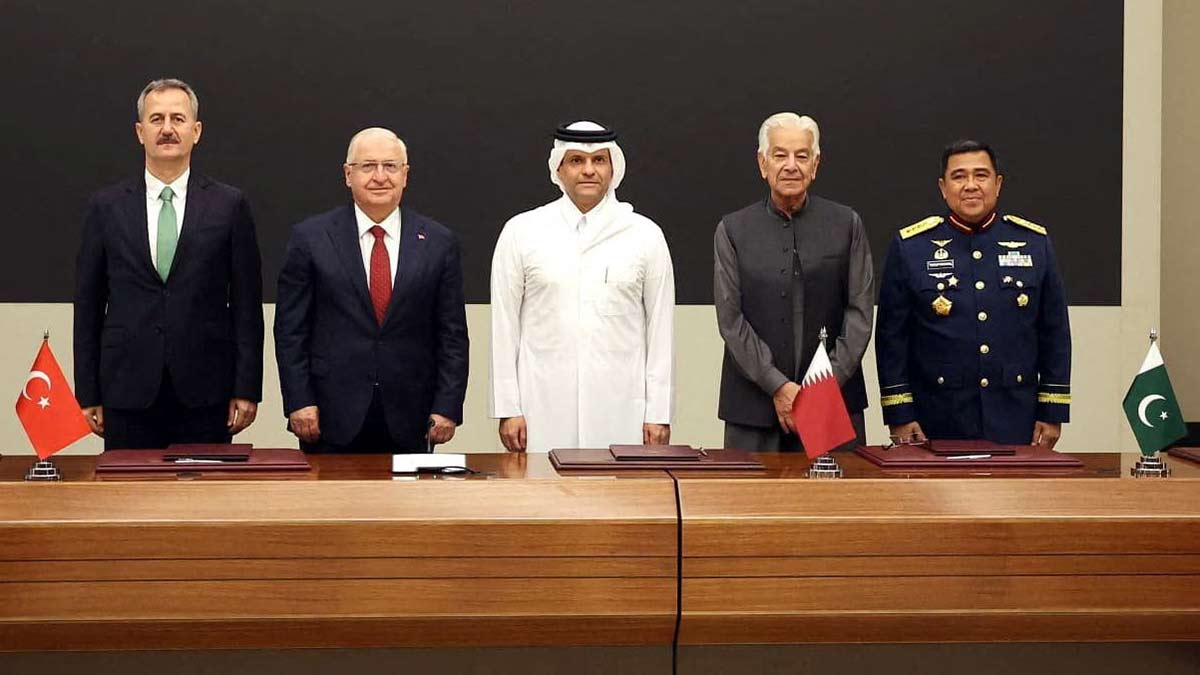
In simple terms, that is what the gang of four—Pakistan, Türkiye, Qatar and Indonesia—who signed last week’s Badr Pact wish to do. May not be to make parts individually, but to explore if they can join hands to make arms.
Many in India are alarmed because Pakistan is there. We have a nasty habit of sighting bogeymen everywhere. The Badr deal is no Mecca Pact or Islamic NATO. It is named grandiosely—after Prophet Muhammad’s legendary victory in 624 in the battle of Badr. But as yet, it’s not even a deal; it’s only an MoU to explore if they can move hand in hand and arm in arm, literally. None of the four is obliged to go to the aid of any of the other three in case of a war. Which means, we can still get away with a Sindoor or Vijay over Pakistan, without Qatar, Türkiye or Indonesia lifting a finger or pulling a trigger on Field Marshal Asim Munir’s behalf. And no concern about the BrahMoses that we sold to Indonesia either. The darts will stay in the quiver.
What then is the gang of four up to? All have their inherent strengths and want to see if they can pool those together. Türkiye is an old NATO member, has a western-standard arms industry. Its engineers know how to put systems together, make world-class drones, naval systems and electronic warfare packs. Qatar has tonnes of petro-money, needs a lot of arms to fend off local foes, and would like to have its own arms factories. Pakistan has a commendable military-industrial base, and a war-scarred military that knows its guns and how to shoot them. Indonesia has a large military that is hungry for arms, and would like to build a few, like the Harimau medium tank it is building with Kaplan of Türkiye.
The beauty of the deal is that it is a partnership among equals, like in the Typhoon case. All four are technologically at par with one another unlike in the case of most joint arms-making bids across the world, most of which are partnerships between a technologically advanced country and a third worlder. Despite all our whitewashing claiming ‘equal partnerships’—let’s admit it—the MiG, Sukhoi, Jaguar, Rafale or the T-90 deals have all been between a seller and a buyer or a donor and a recipient. Co-development, on the other hand, creates deeper ties in research, manufacturing, maintenance, training, and long-term technological partnerships.
There could be pitfalls too. The biggest is that every one of the four has different friends and foes, and each has its own politics. Finding common markets could be challenging. And what if Indonesia or Qatar, both friends of India, deny Pakistan a valve or a gasket in a jointly-made drone in the next war?
IN THE 1960S, the US and Germany ventured to make a battle tank that would outrun and outgun the best in the Soviet inventory. Both developed a lot of technologies for components, but soon they found that the Germans measured lengths in metres, weights in grammes and volumes in litres whereas the Americans were talking in inches, pounds and gallons. Finally, the project was abandoned in 1970, after both sides had burnt up millions of dollars and marks.
A bit like the story of the Tower of Babel in the Old Testament?
